+86 15303735673
 Jessica@frpzs.com
 Technical Data


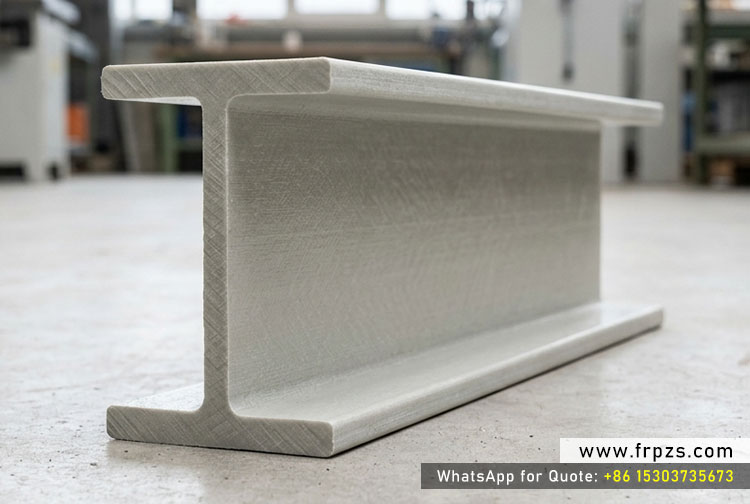
FRP I-beams provide exceptional strength-to-weight ratio for structural applications in corrosive environments
FRP I-Beam: Structural Properties, Specifications, and Applications
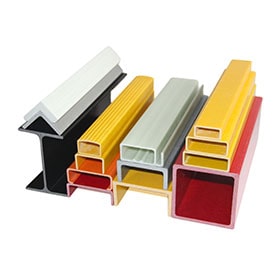
FRP I-beams are among the most efficient structural shapes available for applications requiring high load-bearing capacity with minimal weight. The I-beam geometry concentrates material at the flanges where stress is highest, making it ideal for bending applications. When manufactured via pultrusion, FRP I-beams combine this efficient geometry with the inherent advantages of fiberglass composite: corrosion resistance, electrical insulation, and exceptional durability.
At Henan Zhongsheng Composite Material Co., Ltd, we manufacture FRP I-beams in standard and custom sizes for structural applications worldwide.
1. Why Choose FRP I-Beams Over Steel
The choice between FRP and steel I-beams depends on your specific application requirements:
| Factor | FRP I-Beam | Steel I-Beam | Advantage |
|---|---|---|---|
| Weight | 75-80% lighter | Baseline | FRP |
| Corrosion Resistance | Excellent | Requires coating | FRP |
| Electrical | Non-conductive | Conductive | FRP |
| Maintenance | Minimal | Repainting required | FRP |
| Installation | 30-50% faster | Standard | FRP |
| Initial Cost | Higher | Lower | Steel (initial) |
| Lifecycle Cost (20yr) | 40-60% lower | Higher | FRP |
2. Standard FRP I-Beam Sizes
FRP I-beams are manufactured in a range of standard sizes:
| Designation | Depth (mm) | Flange Width (mm) | Web Thickness (mm) | Flange Thickness (mm) | Weight (kg/m) |
|---|---|---|---|---|---|
| I-100 | 100 | 55 | 6 | 8 | 5.5 |
| I-125 | 125 | 65 | 6 | 9 | 7.2 |
| I-150 | 150 | 75 | 7 | 10 | 9.8 |
| I-175 | 175 | 90 | 7 | 11 | 12.5 |
| I-200 | 200 | 100 | 8 | 12 | 15.8 |
| I-250 | 250 | 125 | 9 | 14 | 23.5 |
| I-300 | 300 | 150 | 10 | 16 | 33.0 |
3. Mechanical Properties
Typical mechanical properties for pultruded FRP I-beams:
| Property | Value (Longitudinal) | Test Method |
|---|---|---|
| Tensile Strength | 250-400 MPa | ASTM D638 |
| Tensile Modulus | 17-25 GPa | ASTM D638 |
| Flexural Strength | 200-350 MPa | ASTM D790 |
| Flexural Modulus | 10-17 GPa | ASTM D790 |
| Compressive Strength | 150-250 MPa | ASTM D695 |
| Shear Strength | 20-30 MPa | ASTM D2344 |
| Density | 1.8-2.2 g/cm³ | ASTM D792 |
4. Section Properties
Typical section properties for standard FRP I-beams:
| Size | Area (mm²) | Ix (cmâ? | Sx (cm³) | rx (mm) | Zx (cm³) |
|---|---|---|---|---|---|
| I-100 | 2,800 | 480 | 96 | 41 | 110 |
| I-125 | 3,650 | 980 | 157 | 52 | 180 |
| I-150 | 4,950 | 1,890 | 252 | 62 | 290 |
| I-200 | 7,980 | 5,400 | 540 | 82 | 620 |
| I-250 | 11,880 | 12,500 | 1,000 | 103 | 1,150 |
| I-300 | 16,650 | 25,200 | 1,680 | 123 | 1,930 |
5. Load Tables: Allowable Uniform Distributed Load (kN/m)
Based on simple span, deflection limit L/200, and allowable flexural stress of 100 MPa:
| Span (m) | I-100 | I-125 | I-150 | I-200 | I-250 | I-300 |
|---|---|---|---|---|---|---|
| 2.0 | 5.5 | 9.0 | 14.5 | 31.0 | 57.5 | 96.5 |
| 3.0 | 2.4 | 4.0 | 6.4 | 13.8 | 25.6 | 42.9 |
| 4.0 | 1.4 | 2.3 | 3.6 | 7.8 | 14.4 | 24.1 |
| 5.0 | 0.9 | 1.4 | 2.3 | 5.0 | 9.2 | 15.4 |
| 6.0 | 0.6 | 1.0 | 1.6 | 3.5 | 6.4 | 10.7 |
Design Note
These values are for preliminary selection only. Actual design should be performed by a qualified structural engineer familiar with pultruded FRP materials, applying appropriate safety factors and checking all limit states.
6. Primary Applications of FRP I-Beams
6.1 Marine and Offshore
- Deck supports and beams: Used as structural supports for offshore decks, their high strength-to-weight ratio enables significant topside weight reduction and improves platform buoyancy.
- Offshore platform walkways: In conjunction with FRP grating, these beams create durable, slip-resistant walkways that maintain structural integrity even in wave splash zones.
- Boat lift structures: Ideal for lifting frames in marinas as they resist moisture-laden air and do not produce rust streaks that can stain or damage vessel hulls.
- Dock pilings and framing: Provides a service life exceeding 50 years in submerged or semi-submerged marine conditions, resisting both oxidation and marine organisms.
6.2 Chemical and Industrial
- Process platform structures: Extensively used in electroplating plants and wastewater treatment facilities where acidic fumes would compromise steel structures in a short period.
- Equipment supports: Supports heavy equipment like reaction vessels and storage tanks; their natural vibration-damping properties help protect connected sensitive machinery.
- Pipe rack systems: Used to support piping carrying corrosive substances; as a poor thermal conductor, FRP reduces heat transfer between the pipe and the support.
- Corrosive environment structural members: Crucial for cooling towers, where I-beams withstand constant high humidity and the chemical treatments used in water cycles.
6.3 Electrical Utilities
- Transformer mounting structures: Eliminates risks of eddy current losses and unwanted electrical paths while providing the necessary mechanical strength for heavy equipment.
- Substation platforms: Provides a critical safety barrier in high-voltage areas, protecting maintenance personnel from accidental grounding or electrocution.
- Cable tray supports: Supports large cable runs without interfering with electromagnetic signals, making them perfect for telecommunications and sensitive data centers.
- High-voltage area walkways: Ensures that maintenance walkways remain non-conductive and safe for technicians under all operating conditions.
6.4 Architecture and Construction
- Canopy structures: 75% lighter than steel, allowing for large, aesthetically pleasing cantilevered designs that can be installed without heavy-duty lifting equipment.
- Roofing supports: Serves as purlins or trusses in environments like indoor swimming pools or industrial warehouses to resist internal moisture and chemical attack.
- Facade elements: Compatible with concrete thermal expansion; its resistance to thermal bridging significantly improves the energy efficiency of building envelopes.
- Architectural features: Can be manufactured in various colors and textures, allowing architects to combine modern performance with traditional aesthetics in public spaces.
7. Connection Methods
FRP I-beams can be connected using various methods:
| Method | Advantages | Notes |
|---|---|---|
| Bolted (through) | Simple, removable | Use stainless steel bolts |
| Plate connections | Strong, versatile | FRP or steel plates |
| Adhesive bonding | Smooth appearance | Surface prep critical |
| welding (specialized) | Strong joints | Requires special equipment |
8. Design Considerations
- Deflection limits: Typically L/200 for structural members
- Safety factors: 3.0 minimum for permanent loads
- Lateral bracing: Provide lateral support to prevent buckling
- Connection design: Ensure connections can develop full member strength
- Service environment: Select appropriate resin for chemical exposure
“FRP I-beams represent a paradigm shift in structural design for corrosive environments. The initial material cost premium is consistently offset by reduced maintenance, extended service life, and easier installationâ”delivering superior lifecycle value.”
Need Custom FRP I-Beams?
Henan Zhongsheng manufactures FRP I-beams:
- Standard sizes: I-100 to I-300
- Custom sizes available
- Polyester, vinyl ester, or epoxy resin
- Various surface finishes
- Technical support for design
Related: FRP Profiles | Equipment | Dies
Browse Products: FRP I-Beam | FRP Channel
Frequently Asked Questions (FAQ)
Q: What is the maximum span for FRP I-beams?
A: Maximum span depends on beam size and load. As a rough guide: I-150 can span 4-6m with light loads; I-250 can span 6-9m. Always verify with structural calculations.
Q: Can FRP I-beams be used outdoors?
A: Yes, with appropriate resin (vinyl ester recommended) and UV-resistant gelcoat. FRP I-beams are ideal for outdoor applications where corrosion is a concern.
Q: How do FRP I-beams perform in fire?
A: Standard FRP has limited fire resistance. For fire-rated applications, specify phenolic resin or fire-retardant additives. FRP will char and self-extinguish with certain formulations.
Q: What connections do you recommend?
A: Through-bolted connections with stainless steel fasteners are most common. Use flat washers to distribute load. For optimal performance, design connections to develop full member strength.
Q: Can you provide engineering calculations?
A: Yes, we can provide preliminary sizing and load tables. For final design, we recommend working with a structural engineer familiar with FRP materials.