+86 15303735673
 Jessica@frpzs.com

 Technical Data



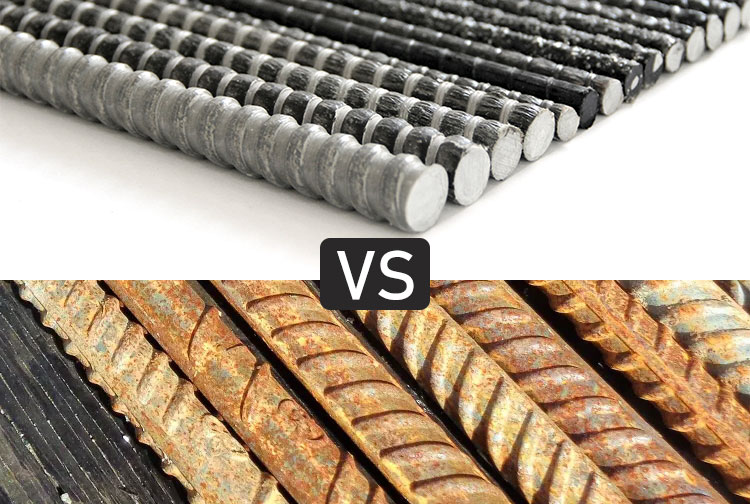
GFRP vs steel
Is GFRP Stronger Than Steel?
GFRP (Glass Fiber Reinforced Polymer) is increasingly being used as a replacement for steel in many construction and industrial applications. But one common question remains: Is GFRP stronger than steel? The answer depends on how you define “strength.”
1. Tensile Strength Comparison
In terms of tensile strength — the ability to resist breaking under tension — GFRP can outperform steel. While mild steel has a tensile strength of around 400–600 MPa, GFRP materials typically range from 600–1200 MPa. This means that GFRP has a much higher strength-to-weight ratio, providing the same or better strength with far less weight.
| Property | Steel | GFRP |
|---|---|---|
| Tensile Strength (MPa) | 400–600 | 600–1200 |
| Density (g/cm³) | 7.8 | 1.9–2.1 |
| Corrosion Resistance | Poor | Excellent |
| Electrical Conductivity | Conductive | Non-conductive |
2. Corrosion Resistance Advantage
Unlike steel, which rusts and deteriorates in humid or chemical environments, GFRP is completely corrosion resistant. This makes it ideal for bridges, marine structures, and chemical plants, where durability and longevity are critical.
3. Lightweight Yet Strong
Because GFRP weighs about one-quarter of steel, it is easier to transport, handle, and install — all while maintaining structural strength. The high strength-to-weight ratio of fiberglass profiles allows engineers to design more efficient and cost-effective structures.
4. Applications Replacing Steel
Today, GFRP is used in:
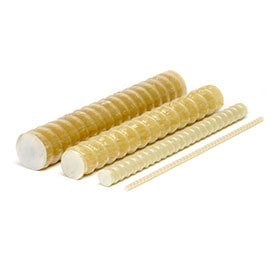
- Rebars and reinforcement in concrete
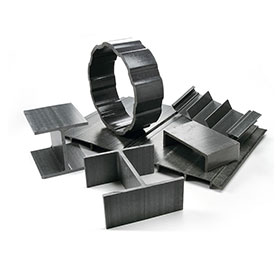
- Structural beams and channels
- Utility poles and handrails
- Bridge decks and marine platforms
5. Conclusion
While GFRP is not “stronger” than steel in every mechanical aspect, it offers superior tensile strength, corrosion resistance, and long-term durability with a much lower weight. For most applications where environmental performance matters, GFRP is the smarter and more sustainable choice.
Contact Us
Henan Zhongsheng Composite Materials Co., Ltd.
Website: www.frpzs.com
Email: Jessica@frpzs.com
WhatsApp: +86 15303735673
Frequently Asked Questions
Q: Is GFRP actually stronger than steel in tensile strength?
A: Yes, in longitudinal tensile strength, pultruded GFRP rebar and rods typically achieve 600 to 1,200 MPa, which is roughly 1.5 to 2 times higher than standard Grade 60 structural steel (400 to 550 MPa). However, because GFRP is an anisotropic material, its strength is concentrated along the fiber direction rather than equally in all directions like steel.
Q: How do GFRP and steel compare in weight and strength-to-weight ratio?
A: GFRP has a density of approximately 1.8 to 2.1 g/cm3 compared to steel at 7.85 g/cm3, making it about 75 percent lighter. When combining its higher tensile strength with one-quarter the weight, GFRP delivers a strength-to-weight ratio roughly 6 to 8 times greater than conventional carbon steel.
Q: What are the key differences in stiffness, yield behavior, and shear strength?
A: While stronger in tension, GFRP has a lower elastic modulus of 40 to 55 GPa for rebars (and 17 to 28 GPa for structural profiles) compared to steel at 200 GPa, resulting in greater deflection under load. Additionally, GFRP exhibits linear-elastic brittle failure without a plastic yield plateau and possesses lower transverse shear strength than steel.
Q: When should engineers choose GFRP over steel in construction and infrastructure?
A: Engineers specify GFRP over steel in chloride-rich marine environments, bridge decks, chemical plants, wastewater facilities, and electromagnetically sensitive zones like hospital MRI rooms or high-voltage substations. In these applications, GFRP prevents rust-induced concrete spalling and delivers a maintenance-free service life exceeding 50 years.
Q: Where can contractors and manufacturers source high-strength GFRP products or pultrusion lines?
A: Henan Zhongsheng Composite Material Co., Ltd. manufactures high-tensile GFRP rebars and structural profiles alongside turnkey pultrusion production lines and precision molds. Visit https://www.frpzs.com or contact Jessica Huang at Jessica@frpzs.com to request mechanical test reports, product datasheets, or factory quotations.