+86 15303735673
 Jessica@frpzs.com
 Technical Data


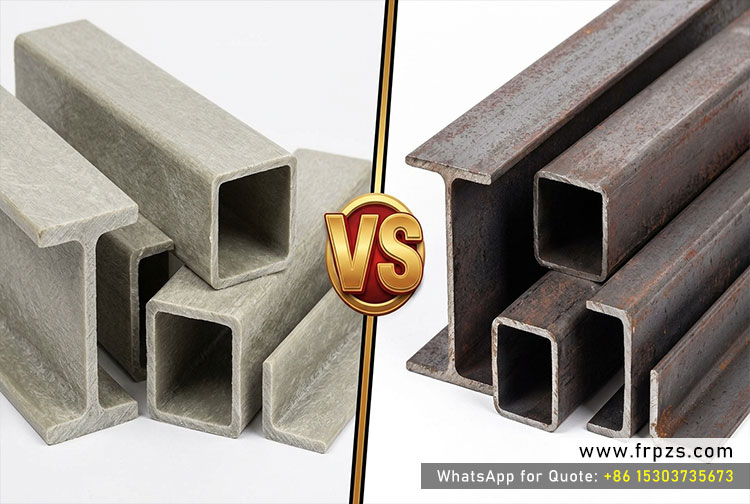
FRP structural profiles offer superior corrosion resistance, lighter weight, and lower lifetime costs compared to traditional steel in corrosive environments
FRP Structural Profiles vs Steel: The Complete Comparison for Infrastructure Projects
When specifying structural materials for infrastructure projects, engineers face a fundamental choice: traditional materials like steel, aluminum, and wood, or high-performance fiber reinforced polymer (FRP) structural profiles. While steel has been the default choice for decades, FRP is increasingly specified in corrosive environments where lifecycle costs, maintenance, and durability are critical considerations.
This comprehensive comparison examines FRP structural profiles against traditional materials across all key parameters—mechanical properties, corrosion resistance, lifecycle costs, and application suitability—to help engineers and project managers make informed specifications.
1. Mechanical Properties: Direct Comparison
Understanding the mechanical characteristics of each material is essential for proper structural design:
| Property | FRP (Pultruded) | Steel (Galvanized) | Aluminum | Wood (Treated) |
|---|---|---|---|---|
| Tensile Strength (MPa) | 250-450 | 370-550 | 90-190 | 40-120 |
| Tensile Modulus (GPa) | 17-25 | 200 | 70 | 9-14 |
| Specific Strength (kN·m/kg) | 150-250 | 50-70 | 70-90 | 40-80 |
| Density (g/cm³) | 1.8-2.2 | 7.85 | 2.7 | 0.4-0.6 |
| Flexural Strength (MPa) | 200-350 | 250-450 | 70-150 | 30-80 |
| Elongation at Break (%) | 1.5-3.0 | 15-25 | 6-15 | 1-2 |
Key Insight
While steel has higher absolute strength and stiffness, FRP offers superior specific strength (strength-to-weight ratio). This means FRP structures can achieve equivalent load-bearing capacity at a fraction of the weight—critical for applications where weight is a constraint.
2. Corrosion Resistance: Where FRP Excels
Corrosion is the primary failure mode for steel in many environments. FRP's inherent corrosion resistance transforms project economics:
| Environment | FRP Performance | Steel Performance | FRP Advantage |
|---|---|---|---|
| Saltwater / Marine | Excellent - No corrosion | Poor - Rapid corrosion | Critical |
| Chlorine / Chemicals | Excellent - Resists most | Poor - Pitting/attack | Critical |
| Acid / Alkali | Excellent (Vinyl Ester) | Poor - Chemical attack | Critical |
| Humid / Tropical | Excellent - No rust | Poor - Rust forms | Significant |
| UV Exposure | Good (with gelcoat) | Paint degrades | Moderate |
| High Temperature | -30 to +100°C | -40 to +400°C | Steel for extreme heat |
Service Life Comparison
| Environment | FRP Service Life | Galvanized Steel | Stainless Steel 316 |
|---|---|---|---|
| Marine (Splash Zone) | 50-75+ years | 5-10 years | 15-25 years |
| Chemical Plant | 30-50 years | 3-7 years | 10-15 years |
| Wastewater | 50+ years | 5-8 years | 10-15 years |
| Road/Highway | 50+ years | 15-25 years | 25-35 years |
3. Lifecycle Cost Analysis
Initial material cost is only one factor. True project economics require lifecycle cost analysis:
3.1 Cost Component Comparison
| Cost Factor | FRP | Galvanized Steel | Stainless Steel 316 |
|---|---|---|---|
| Material Cost (relative) | 2-3x steel | Baseline | 5-8x steel |
| Fabrication Cost | Similar to steel | Baseline | Higher (special tools) |
| Installation Cost | 30-50% lower (lighter) | Baseline | Baseline |
| Annual Maintenance | $0-50/yr | $200-500/yr | $50-150/yr |
| Replacement Interval | 50-75 years | 10-20 years | 20-30 years |
| 20-Year Total Cost | Lowest | Moderate | Highest |
3.2 Real-World Example: Chemical Plant Platform
Project: 50m² elevated platform in chemical processing plant
| Cost Category | FRP | Galvanized Steel | Stainless Steel 316 |
|---|---|---|---|
| Materials | $25,000 | $12,000 | $45,000 |
| Installation | $3,000 | $6,000 | $6,000 |
| 10-Year Maintenance | $500 | $5,000 | $1,500 |
| 20-Year (2 replacements) | $29,000 | $50,000+ | $75,000+ |
| Lifecycle Savings | — | 42% more | 160% more |
4. Weight and Installation Advantages
FRP is approximately 75-80% lighter than steel, with significant installation benefits:
4.1 Weight Comparison
| Profile Type | FRP Weight (kg/m) | Steel Weight (kg/m) | Weight Savings |
|---|---|---|---|
| 50×50×5mm Square Tube | 2.0 | 6.9 | 71% |
| 100×100×10mm Square Tube | 7.5 | 27.8 | 73% |
| I-Beam (100mm depth) | 5.5 | 17.5 | 69% |
| Channel (100mm depth) | 4.0 | 13.5 | 70% |
4.2 Installation Benefits
- Reduced equipment needs: Smaller cranes and lifting equipment
- Faster installation: 30-50% time savings typical
- Lower labor costs: Fewer workers needed for handling
- Access constraints: Easier in confined spaces
- Foundation loads: Reduced structural support requirements
5. Electrical and Safety Properties
| Property | FRP | Steel | Application Benefit |
|---|---|---|---|
| Electrical Conductivity | Non-conductive | Conductive | Safety in high-voltage areas |
| Thermal Conductivity | Low (0.3-0.4 W/m·K) | High (45 W/m·K) | Thermal breaks |
| Magnetic Properties | Non-magnetic | Magnetic | Sensitive equipment areas |
| Fire Performance | Self-extinguishing (FR) | Non-combustible | Steel for fire zones |
| Spark/Ignition Risk | None | Yes (impact) | Hazardous environments |
6. When to Choose FRP vs Steel
Choose FRP When:
- Environment is corrosive (marine, chemical, wastewater)
- Weight is a constraint (rooftop, elevated structures)
- Electrical insulation is required
- Long-term maintenance access is difficult
- Lifecycle cost is prioritized over initial cost
- Non-magnetic properties are needed
Choose Steel When:
- Extreme load-bearing is required
- High-temperature resistance is needed
- Impact resistance is critical
- Budget is primary constraint (initial only)
- Fire resistance (structural integrity) is paramount
- Standard construction with minimal environmental challenge
7. Common Applications by Industry
FRP Preferred Applications
- Marine: Docks, piers, boat lifts, offshore platforms
- Chemical: Process platforms, tank supports, pipe racks
- Water/Wastewater: Clarifier walkways, platform supports
- Electrical: Transformer yards, substation structures
- Transportation: Bridge components, sound barrier posts
- Architecture: Canopies, decorative structures
Steel Preferred Applications
- Heavy industrial: High-load cranes, structural frames
- High-rise: Primary structural members
- Extreme temperature: Furnace supports, cryogenic
- Impact: Crash barriers, security barriers
“The choice between FRP and steel is not about which material is universally superior—it is about matching the material to the application. In corrosive environments where lifecycle costs dominate, FRP structural profiles consistently deliver superior value. In applications requiring extreme strength or fire resistance, steel remains appropriate. Smart engineering means selecting the right material for each specific condition.”
Need FRP Structural Profiles?
Henan Zhongsheng manufactures high-quality FRP structural profiles:
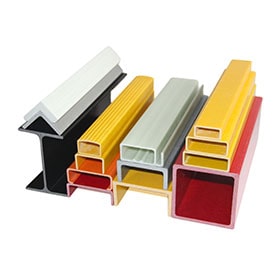
- Square tubes, round tubes, I-beams, channels, angles
- Standard and custom sizes
- Polyester, vinyl ester, or epoxy resin
- Various surface finishes
- Technical support for specification
Browse Products: All FRP Profiles | FRP I-Beam | FRP Channel
Frequently Asked Questions (FAQ)
Q: Can FRP structural profiles replace steel in all applications?
A: Not in all applications. FRP is ideal for corrosive environments, electrical insulation, and weight-sensitive applications. However, for extreme loads, high temperatures, or fire-rated assemblies, steel may still be required. Always consult with a structural engineer.
Q: What is the design life of FRP structural profiles?
A: Properly specified FRP structural profiles have a design life of 50-75+ years in non-corrosive to moderately corrosive environments. This exceeds the service life of galvanized steel in similar conditions.
Q: How do I connect FRP profiles to steel structures?
A: Use stainless steel fasteners (316L recommended) with proper bearing washers. Adhesive bonding with structural epoxy is also effective. Avoid direct contact between dissimilar metals without proper isolation.
Q: Are FRP structural profiles fire-rated?
A: Standard FRP has limited fire resistance. Fire-rated (FR) formulations are available that meet ASTM E84 Class A requirements. For fire-critical applications, specify phenolic resin or fire-retardant additives.
Q: What design codes apply to FRP structural profiles?
A: Key design standards include: ASCE/SEI 48-05 (Pultruded FRP Structures), ACI 440 (FRP Reinforcement), Eurocode 9 (Aluminium), and various national building codes that reference these standards.