+86 15303735673
 Jessica@frpzs.com
 Technical Data


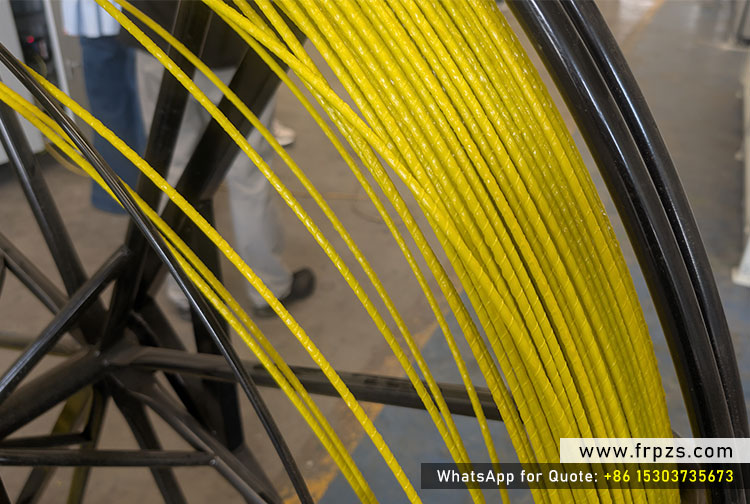
State-of-the-art FRP rebar production line with multi-line pultrusion system for high-volume manufacturing
FRP Rebar Manufacturing Process: From Raw Materials to Quality Production
Understanding how FRP (Fiber Reinforced Polymer) rebar is manufactured is essential for engineers, project managers, and procurement specialists evaluating this emerging reinforcement technology. The manufacturing process directly impacts mechanical properties, durability, and consistency of the final product. This guide provides a comprehensive overview of FRP rebar production, quality control, and what to look for when sourcing from manufacturers.
At Henan Zhongsheng Composite Material Co., Ltd, we operate advanced multi-line pultrusion systems capable of producing over 3,000 tons of FRP rebar annually for projects worldwide.
1. Raw Materials: The Foundation of Quality
FRP rebar quality begins with raw material selection. The three primary components are:
1.1 Fiberglass Reinforcement
- E-Glass (E-CR Glass): Most common, good mechanical properties, cost-effective
- E-CR Glass: Corrosion-resistant variant, superior durability in alkaline environments
- S-Glass: Higher strength (20-30% more than E-glass), used for high-performance applications
- Roving: Continuous strands, primary load-bearing reinforcement
- Mat/Surfacing Veil: Surface reinforcement, improves durability and surface finish
| Fiber Type | Tensile Strength (MPa) | Modulus (GPa) | Elongation (%) | Cost Index |
|---|---|---|---|---|
| E-Glass | 3,100-3,800 | 72-76 | 4.5-5.5 | 1.0 (baseline) |
| E-CR Glass | 3,300-4,000 | 78-82 | 4.5-5.0 | 1.2-1.4 |
| S-Glass | 4,800-5,500 | 86-90 | 5.0-5.5 | 2.5-3.0 |
1.2 Resin Matrix
- Vinyl Ester: Best corrosion resistance, recommended for concrete reinforcement
- Polyester: Cost-effective, suitable for non-corrosive environments
- Epoxy: Superior mechanical properties, highest cost
1.3 Additives and Fillers
- Fillers: Calcium carbonate, silica flour (reduces cost, improves processing)
- UV stabilizers: Protects against ultraviolet degradation
- Fire retardants: For fire-rated applications
- Pigments: Color for identification (grey, black, red)
2. The Pultrusion Process: Step by Step
Pultrusion is the primary manufacturing method for FRP rebar, producing continuous, constant-cross-section profiles with exceptional consistency.
2.1 Process Overview
- Fiber roving creel: Multiple roving packages mounted on creel frame
- Resin impregnation: Fibers pass through resin bath for thorough wet-out
- Preformer: Guides and shapes the wet fiber bundle
- Heated die: Cures the resin (120-150°C for vinyl ester)
- Pulling system: Continuous pull through the die (0.5-2.0 m/min)
- Cut-off saw: Cuts to required lengths
2.2 Key Process Parameters
| Parameter | Typical Range | Impact |
|---|---|---|
| Die Temperature | 120-150°C | Cure quality, surface finish |
| Pull Speed | 0.5-2.0 m/min | Production rate, cure completeness |
| Resin Temperature | 20-25°C | Viscosity, fiber wet-out |
| Fiber Content | 60-75% by weight | Mechanical properties |
| Die Pressure | 2-5 bar | Compaction, void content |
3. FRP Rebar Sizes and Specifications
Standard FRP rebar diameters and corresponding specifications:
| Nominal Dia. (mm) | Actual Dia. (mm) | Cross-Section (mm²) | Tensile Load (kN) | Tensile Strength (MPa) | Weight (kg/m) |
|---|---|---|---|---|---|
| 6 | 6 | 28 | 8-10 | 600-800 | 0.08 |
| 8 | 8 | 50 | 15-20 | 600-800 | 0.12 |
| 10 | 10 | 78 | 25-32 | 600-800 | 0.18 |
| 12 | 12 | 113 | 35-45 | 600-800 | 0.27 |
| 14 | 14 | 154 | 48-60 | 600-800 | 0.36 |
| 16 | 16 | 201 | 60-80 | 600-800 | 0.47 |
| 19 | 19 | 283 | 85-110 | 600-800 | 0.66 |
| 22 | 22 | 380 | 115-150 | 600-800 | 0.89 |
| 25 | 25 | 491 | 150-190 | 600-800 | 1.15 |
| 32 | 32 | 804 | 240-320 | 600-800 | 1.89 |
4. Quality Control: What Reputable Manufacturers Do
Quality FRP rebar requires rigorous testing at every stage of production:
4.1 Raw Material Inspection
- Certificate of Analysis (CoA) from fiber suppliers
- Resin viscosity and gel time testing
- Fiber tensile testing (batch sampling)
4.2 In-Process Quality Checks
- Resin bath temperature monitoring
- Die temperature profile verification
- Pull force monitoring (detects process variations)
- Visual inspection for surface defects
4.3 Final Product Testing
| Test | Method | Frequency | Acceptance Criteria |
|---|---|---|---|
| Tensile Strength | ASTM D7205 | Every batch | ≥ 600 MPa |
| Tensile Modulus | ASTM D7205 | Every batch | 40-55 GPa |
| Fiber Content | ASTM D2584 | Daily | 65-75% |
| Void Content | ASTM D2734 | Weekly | < 2% |
| Dimensional Check | Calipers | Continuous | ± 0.2mm |
| Surface Quality | Visual | 100% | No voids, cracks |
5. Surface Treatments: Sand Coating and Helically Wrapped
FRP rebar requires surface treatment to ensure adequate bond with concrete:
5.1 Sand Coating (Embossed)
- Fine silica sand bonded to surface during pultrusion
- Creates mechanical interlock with concrete
- Standard for most applications
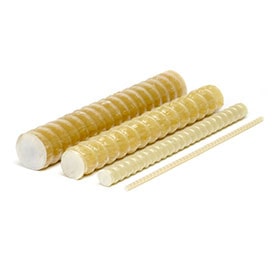
5.2 Helically Wrapped
- Spiral wound fiberglass or sand strand
- Higher bond strength than sand coating
- Recommended for high-stress applications
6. Manufacturing Capacity and Lead Times
| Production Line Type | Annual Capacity | Diameter Range | Typical Lead Time |
|---|---|---|---|
| Single Line | 300-500 tons | 6-16 mm | 2-4 weeks |
| Multi-Line (3-line) | 800-1,200 tons | 6-25 mm | 3-6 weeks |
| Multi-Line (5-line) | 1,500-3,000 tons | 6-32 mm | 4-8 weeks |
7. Certifications and Standards
Ensure your FRP rebar supplier complies with relevant standards:
- ACI 440.6: Specification for FRP rebar reinforcement
- ASTM D7205: Test method for tensile properties of FRP rebars
- ASTM D7959: Specification for FRP bars for concrete reinforcement
- CSA S807: Canadian standard for FRP reinforcement
- ISO 9001: Quality management system certification
What to Ask Your Supplier
- Can you provide test certificates for each batch?
- What is your fiber content and void content?
- What resin system do you use?
- Do you perform tensile testing on every batch?
- What surface treatment do you provide?
8. Why Manufacturing Quality Matters
FRP rebar performance depends on manufacturing quality. Poor-quality rebar may have:
- Low fiber content: Reduces tensile strength
- High void content: Compromises durability
- Inconsistent dimensions: Affects concrete cover and bond
- Poor surface treatment: Reduces concrete bond strength
- Inadequate cure: Leads to premature failure
“FRP rebar is a high-performance material, but only when manufactured to exacting standards. The difference between quality FRP rebar and inferior product may not be visible to the naked eye—but will become apparent over the 75+ year design life of the structure.”
Need Quality FRP Rebar?
Henan Zhongsheng manufactures FRP rebar to the highest quality standards:
- Annual capacity: 3,000+ tons
- Diameters: 6mm to 32mm+
- Vinyl ester resin for superior durability
- 100% batch testing with certificates
- Sand coated and helically wrapped options
Browse Products: FRP Rebar | All FRP Profiles
Related: Pultrusion Equipment | Pultrusion Dies
Frequently Asked Questions (FAQ)
Q: What is the typical lead time for FRP rebar orders?
A: Standard sizes: 2-4 weeks for orders up to 50 tons. Larger orders or custom sizes: 4-8 weeks. Peak season (spring) may require additional lead time.
Q: What is the minimum order quantity?
A: We accept orders starting at 1 ton for standard sizes. For custom diameters or large projects, we offer volume pricing.
Q: How is FRP rebar packaged for shipping?
A: Standard packaging: bundles of 100-200 bars, strapped to pallets. Custom packaging (specific bundle sizes, branded tags) available.
Q: Can you provide test certificates?
A: Yes, every batch comes with full test certificates including tensile strength, modulus, fiber content, and dimensional verification.
Q: What surface treatment do you recommend?
A: Sand coating is suitable for most applications. For high-stress applications or where maximum bond strength is critical, helically wrapped is recommended.