+86 15303735673
 Jessica@frpzs.com
 Technical Data


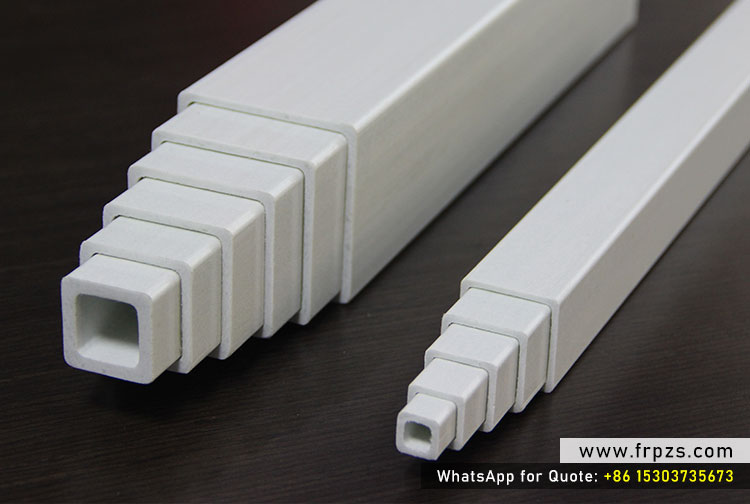
FRP square tubes provide superior structural performance with exceptional corrosion resistance for industrial and construction applications
FRP Square Tube: Complete Technical Guide for Structural Applications
FRP square tubes are among the most widely used pultruded structural profiles in the fiberglass composites industry. Their rectangular cross-section offers distinct advantages over round tubes in structural applications: higher moment of inertia in one direction, easier connection to flat surfaces, and more efficient stacking and packaging. This guide covers mechanical properties, design considerations, and applications to help engineers and project managers specify FRP square tubes correctly.
At Henan Zhongsheng Composite Material Co., Ltd, we have manufactured FRP square tubes for over 15 years, supplying critical structural components to projects worldwide.
1. Understanding FRP Square Tube
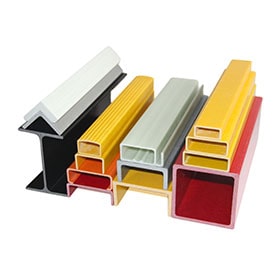
An FRP square tube is a pultruded hollow structural profile with a square cross-section. The manufacturing process ensures:
- Continuous fiberglass reinforcement — E-glass or E-CR glass rovings and mats aligned for optimal strength
- Consistent wall thickness — Typically 3mm to 12mm depending on size and load requirements
- Protective gelcoat — 0.3-0.5mm UV-resistant surface layer
- Dimensional stability — Precision tolerances (±0.5mm on dimensions)
Why Choose Square Over Round?
| Factor | FRP Square Tube | FRP Round Tube | Notes |
|---|---|---|---|
| Moment of Inertia (per width) | Higher | Lower | Square has more material away from neutral axis |
| Connection to Flat Surfaces | Easier | Requires special fittings | Bolting, welding directly to flat surfaces |
| Stacking Efficiency | Higher | Lower | Better warehouse/storage efficiency |
| torsional Resistance | Higher | Lower | Better for twisting loads |
| Aesthetic/Architectural | Modern appearance | Traditional | Often preferred for visible structures |
2. Standard Sizes and Specifications
FRP square tubes are manufactured in a comprehensive range of standard sizes:
Standard Size Range
| Nominal Size (mm) | Actual O.D. (mm) | Wall Thickness (mm) | Weight (kg/m) | Moment of Inertia (cm⁴) |
|---|---|---|---|---|
| 25 × 25 | 25 × 25 | 3.0-5.0 | 0.55-0.85 | 0.45-0.68 |
| 30 × 30 | 30 × 30 | 3.0-5.0 | 0.70-1.05 | 0.80-1.20 |
| 38 × 38 | 38 × 38 | 3.5-6.0 | 1.00-1.60 | 1.80-2.80 |
| 40 × 40 | 40 × 40 | 3.5-6.0 | 1.10-1.75 | 2.20-3.40 |
| 50 × 50 | 50 × 50 | 4.0-8.0 | 1.55-2.85 | 4.80-8.50 |
| 60 × 60 | 60 × 60 | 5.0-8.0 | 2.30-3.50 | 10.2-14.8 |
| 75 × 75 | 75 × 75 | 5.0-10.0 | 2.90-5.40 | 20.0-35.0 |
| 80 × 80 | 80 × 80 | 5.0-10.0 | 3.10-5.80 | 24.5-42.0 |
| 100 × 100 | 100 × 100 | 6.0-12.0 | 4.70-8.80 | 58.0-102.0 |
| 120 × 120 | 120 × 120 | 8.0-12.0 | 7.50-10.80 | 132.0-185.0 |
| 150 × 150 | 150 × 150 | 10.0-15.0 | 11.60-16.80 | 325.0-450.0 |
3. Mechanical Properties
Mechanical properties for standard polyester resin pultruded square tubes:
| Property | Typical Value | Test Method | Notes |
|---|---|---|---|
| Tensile Strength (Longitudinal) | 250-400 MPa | ASTM D638 | Direction of pultrusion |
| Tensile Modulus | 17-25 GPa | ASTM D638 | Longitudinal direction |
| Flexural Strength | 200-350 MPa | ASTM D790 | Major axis |
| Flexural Modulus | 10-17 GPa | ASTM D790 | |
| Compressive Strength | 150-250 MPa | ASTM D695 | |
| Shear Strength | 20-30 MPa | ASTM D2344 | Interlaminar |
| Density | 1.8-2.2 g/cm³ | ASTM D792 |
4. Resin Selection Guide
| Resin Type | Chemical Resistance | Temperature | UV Resistance | Cost | Best For |
|---|---|---|---|---|---|
| Polyester (ISO) | Good | -20 to +65°C | Moderate | Lowest | General industrial, construction |
| Vinyl Ester | Excellent | -20 to +80°C | Good | Medium | Chemical, marine |
| Epoxy | Excellent | -30 to +100°C | Good | High | High-performance |
5. Primary Applications
5.1 Structural Framework
- Machine frames: Non-magnetic, non-conductive, corrosion-resistant
- Warehouse racking: Lightweight, rust-free, easy installation
- Modular buildings: Quick assembly, low maintenance
- Equipment supports: Vibration-damping, stable dimensions
5.2 Marine and Offshore
- Deck supports: Saltwater resistant, non-slip surface options
- Railings and handrails: Low maintenance, aesthetic options
- Boat building: Lightweight, strong, corrosion-free
- Offshore platform components: Long service life in harsh environments
5.3 Electrical Applications
- Transformer mounting: Excellent dielectric properties
- Substation structures: Non-conductive, safety priority
- Cable trays: Non-magnetic, corrosion-resistant
- High-voltage work platforms: Safety insulation
5.4 Infrastructure
- Bridge components: Lightweight, corrosion-resistant, low maintenance
- Signage supports: Impact-resistant, weather-stable
- Noise barrier posts: Corrosion-resistant for highway use
- Parking structure components: Deicing salt resistant
6. Design Calculations
6.1 Bending Stress
Maximum bending stress:
σ = M / S ≤ Fallowable
- M: Maximum bending moment (N·m)
- S: Section modulus (m³) = I / y
- Fallowable: Typically 75-100 MPa for design (with safety factor)
6.2 Deflection Check
δmax ≤ L / 200 (for most structural applications)
6.3 Column Buckling
Critical load for pinned-pinned columns:
Pcr = π² EI / L²
Safety Factors
Apply minimum safety factors of 3.0 for permanent loads and 2.5 for temporary loads. For dynamic loads or impact, increase to 4.0-5.0. Always verify with a structural engineer familiar with FRP materials.
7. Connection Details
7.1 Bolted Connections
- Bolt size: M8-M16 typically adequate
- Bolt material: 316 stainless steel recommended
- Bearing area: Use flat washers to distribute load
- Hole size: Drill 1mm larger than bolt diameter
7.2 Adhesive Bonding
- Surface prep: Sand, clean, prime
- Adhesive: Epoxy or polyurethane structural adhesive
- Cure time: 24-72 hours depending on adhesive
7.3 Mechanical Fasteners
- Self-tapping screws: For thin-walled sections
- rivets: Monel or stainless steel rivets
- Clamping: For temporary or adjustable connections
8. Comparison: FRP Square Tube vs Steel
| Factor | FRP Square Tube | Steel (Galvanized) | FRP Advantage |
|---|---|---|---|
| Weight | 1.8-2.2 g/cm³ | 7.85 g/cm³ | 75-80% lighter |
| Specific Strength | 150-250 kN·m/kg | 50-70 kN·m/kg | 2-3x higher |
| Corrosion Resistance | Excellent | Poor | No painting needed |
| Electrical | Non-conductive | Conductive | Safety benefit |
| Maintenance | Minimal | High (repainting) | 80% cost savings |
| Service Life | 50+ years | 15-25 years | 2-3x longer |
| Initial Cost | 20-40% higher | Lower | Steel lower upfront |
| Total Cost (30 years) | Lower | Higher | FRP 40-60% savings |
9. Installation Guidelines
- Handling: Use appropriate lifting equipment for long sections
- Cutting: Carbide-tipped saw blades; avoid overheating
- Drilling: Peck drilling to prevent delamination
- Fastening: Pre-drill holes 1mm oversized
- Support spacing: Follow load tables; do not exceed spans
- Thermal expansion: Account for 10-15 × 10⁻⁶/°C
“FRP square tubes deliver an optimal balance of strength, weight, and corrosion resistance for structural applications. While the initial material cost exceeds steel by 20-40%, the total lifecycle cost—considering reduced maintenance, extended service life, and easier installation—typically makes FRP the more economical choice in corrosive or electrically sensitive environments.”
Need Custom FRP Square Tubes?
Henan Zhongsheng manufactures FRP square tubes in standard and custom sizes. We offer:
- Sizes from 25×25mm to 150×150mm+
- Custom wall thicknesses (3-15mm)
- Polyester, vinyl ester, or epoxy resin options
- Various surface finishes
- Technical support for design calculations
Browse Our Products: FRP Square Tube | FRP Round Tube | All FRP Profiles
Related: Pultrusion Equipment | Pultrusion Dies
Frequently Asked Questions (FAQ)
Q: What is the maximum span for FRP square tube structural applications?
A: Maximum span depends on size, wall thickness, and load. As a rough guide: 50×50×5mm tube can span 2.0-2.5m with light loads; 100×100×10mm can span 4.0-5.0m. Always verify with calculations or consult our engineering team.
Q: Can FRP square tubes be used outdoors?
A: Yes, with proper resin and gelcoat. Vinyl ester or epoxy resin with UV-resistant gelcoat provides the best outdoor performance. Standard polyester is suitable for less demanding outdoor applications.
Q: How do FRP square tubes perform in fire?
A: Standard FRP has limited fire resistance. For fire-rated applications, specify phenolic resin or fire-retardant additives. Some formulations achieve ASTM E84 Class A fire ratings.
Q: What fasteners should be used with FRP square tubes?
A: Use 316 stainless steel fasteners. Avoid galvanized steel, which can corrode in moist environments. Pre-drill holes 1mm larger than bolt diameter to prevent stress concentrations.
Q: Can FRP square tubes be painted?
A: Yes, but surface preparation is critical. Sand, clean, and use compatible primers. However, the gelcoat typically provides sufficient UV protection and aesthetics without painting.