+86 15303735673
 Jessica@frpzs.com
 Technical Data


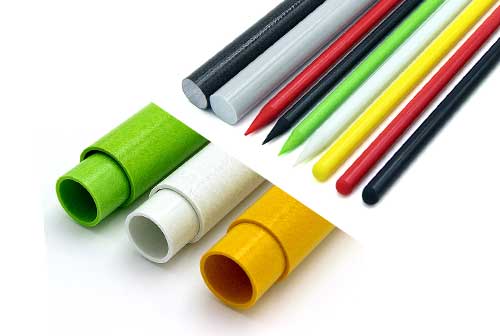
Structural Brief: Choosing between solid fiberglass rods and hollow fiberglass rods (tubes) is more than a matter of weight. It is a decision based on Flexural Rigidity and Material Efficiency. While solid rods offer maximum puncture and impact resistance, hollow sections utilize geometry to provide superior stiffness-to-weight ratios. Henan Zhongsheng, with two decades of pultrusion experience, provides a technical breakdown to help you specify the correct profile for your application.
1. Solid Fiberglass Rods: Maximum Material Density
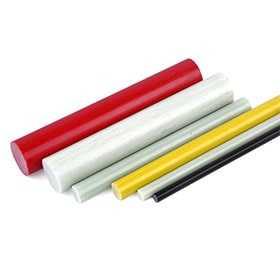
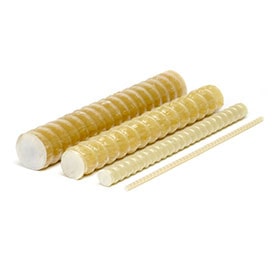
Solid fiberglass rods are characterized by a 100% resin-and-fiber fill. This pultruded architecture ensures that the entire cross-section is active in resisting loads.
- Unmatched Impact Resistance: Because there is no internal void, solid rods are nearly impossible to crush or kinking, making them ideal for high-vibration and heavy-impact environments.
- Easier Secondary Machining: You can drill, tap, or thread solid rods across the entire diameter without compromising structural integrity or risking wall collapse.
- Typical Applications: Antennas, high-strength tool handles, flag poles for high-wind areas, and structural pins in civil engineering.
2. Hollow Fiberglass Rods: The Geometry of Efficiency
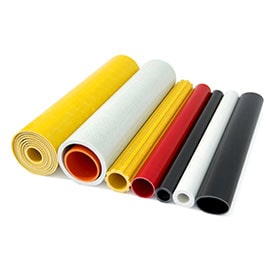
Hollow fiberglass rods (often called FRP tubes) leverage the fact that in bending, the outermost material does the most work. By removing the "neutral axis" material (the center), we achieve significant advantages:
- High Strength-to-Weight Ratio: A hollow tube can often provide nearly the same Bending Stiffness as a solid rod of the same diameter, but at 40% to 60% less weight.
- Internal Utility: The hollow core allows for the integration of electrical wiring, sensors, or hydraulic lines—critical for telecommunications and robotic arms.
- Lower Thermal Mass: Hollow sections respond faster to ambient temperature changes and offer better vibration damping in precision instruments.
- Typical Applications: Lightweight tent poles, telescoping tools, pruning saw extensions, and cross-arms for utility poles.
Engineering Benchmarking: Rod vs. Tube
| Property Metric | Solid Fiberglass Rod | Hollow Fiberglass Rod (Tube) |
|---|---|---|
| Bending Stiffness | High (Absolute) | Superior (Per Unit Weight) |
| Crush Resistance | Excellent (Solid core) | Moderate (Wall-thickness dependent) |
| Weight (Same OD) | 100% Base Weight | ~40% - 70% Base Weight |
| Cost per Foot | Higher (More raw material) | Lower (Less material used) |
| Best For... | High Stress & Impact | Portability & Efficiency |
3. Decision Matrix: Which One Should You Specify?
To determine the "better" profile, ask three engineering questions:
1. Is the load primarily Axial or Flexural? If you need to resist direct compression or impact from all angles, solid rods are safer. If you need to resist bending over a long span while keeping the structure light, hollow rods are technically superior.
2. Does weight impact logistics? For global shipping or manual handling (like telescoping poles), the weight savings of a hollow section translate directly into lower operational costs.
3. Are there environmental stressors? In extreme heat, a solid rod's thermal expansion is more predictable. In marine environments, hollow sections must be properly capped to prevent internal water ingress, whereas solid rods are inherently immune.
Professional FAQ: Solid vs. Hollow Rods
Q1: Will a hollow rod break more easily than a solid one?
A: Not necessarily. In terms of Bending Moment, a hollow rod with a larger diameter and thin wall can actually be stronger than a thin solid rod, while weighing less. It depends entirely on the ratio of the wall thickness to the outer diameter.
Q2: Can solid rods be used as insulators in high-voltage areas?
A: Yes. Solid fiberglass rods are excellent dielectric insulators. We often recommend them for "hot sticks" and electrical spacers because their lack of a void prevents moisture from accumulating inside, which could otherwise create a conductive path.
Q3: How do you join hollow rods together?
A: Hollow rods are ideal for joining because you can use internal "ferrules" or sleeves. This makes them perfect for telescoping systems or multi-section tent poles.
Q4: Are solid rods more durable in outdoor fencing?
A: Yes. For agricultural or security fencing, solid rods withstand animal impacts and mechanical abrasion better than hollow tubes, which could dent or collapse under concentrated point loads.
Q5: Which is better for DIY kite or flag making?
A: Small-diameter solid rods are preferred for kites due to their incredible flexibility and "memory" (ability to snap back to shape). For large flags, hollow tubes provide the necessary rigidity without being too heavy to lift.
Q6: Does Henan Zhongsheng offer custom wall thicknesses for hollow rods?
A: Absolutely. We can adjust our pultrusion dies to create specific wall thicknesses, allowing you to fine-tune the balance between weight and crush resistance for your specific project.
Expert FRP Solutions from Henan Zhongsheng
Whether your project demands the indestructible nature of solid fiberglass rods or the optimized efficiency of hollow tubes, Henan Zhongsheng Composite Materials Co., Ltd. has the technical expertise to deliver. With 20+ years in the pultrusion industry, we provide high-performance FRP profiles to sectors ranging from telecommunications to heavy construction.
Contact Jessica Huang for a Technical Quote:
- Email: Jessica@frpzs.com
- WhatsApp: +86 15303735673
- Global Logistics: Supplying premium fiberglass rods to India, USA, Australia, and Europe.