+86 15303735673
 Jessica@frpzs.com
 Technical Data


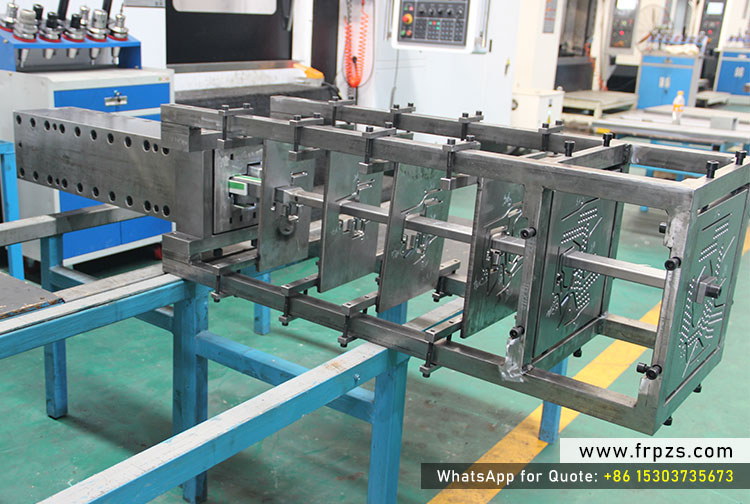
Precision pultrusion die design is the foundation of high-quality FRP profile manufacturing
Pultrusion Die Design: The Complete Technical Guide for FRP Profile Manufacturers
In pultrusion manufacturing, the die is not just a tool—it is the heart of the process. A poorly designed die produces defective profiles regardless of how well-tuned the machine parameters are. Yet die design remains one of the most under-documented aspects of the composites industry. At Henan Zhongsheng Composite Material Co., Ltd, with over 15 years of precision die manufacturing experience serving clients in 30+ countries, we have compiled this comprehensive technical guide to help engineers, plant managers, and purchasers understand what makes a great pultrusion die.
1. What Does a Pultrusion Die Actually Do?
A pultrusion die serves four simultaneous functions that must be balanced in its design:
- Shaping: Imparts the profile's cross-sectional geometry to the fiber-resin composite.
- Impregnation zone: The entry section where resin saturates the fiber reinforcement under pressure.
- Curing zone: The heated section where the resin undergoes cross-linking and hardens.
- Sizing zone: The final section that sets the exact dimensions and surface finish of the cured profile.
Industry Fact
A properly designed die contributes to 70% of the final profile quality. The remaining 30% is divided among raw material selection, process parameters, and equipment maintenance. This is why leading manufacturers invest heavily in die design and treat it as a core competitive advantage.
2. Die Geometry: Entry, Transition, and Sizing Zones
A pultrusion die is divided into three functional zones along its length. Getting the proportions right for each zone is critical for quality and production efficiency.
| Die Zone | Function | Typical Length | Key Design Considerations |
|---|---|---|---|
| Impregnation Zone (Entry) | Saturate fibers with resin under pressure | 20-40% of total die length | Tapered entry, surface finish Ra 0.4-0.8 μm |
| Curing Zone (Heated) | Heat the resin to initiate and complete cure | 50-60% of total die length | Multi-zone temperature control, uniform heat distribution |
| Sizing Zone (Exit) | Set final dimensions and surface finish | 20-30% of total die length | Mirror polish, tight tolerance (±0.02mm), water cooling |
Total Die Length Calculation
The minimum die length depends on the profile's thickest section and the resin cure kinetics. A commonly used formula:
Ldie = (tmax × Vpull) ÷ Kcure + Lentry + Lsizing
- tmax = Maximum wall thickness or cross-section (mm)
- Vpull = Pull speed (m/min)
- Kcure = Cure constant (typically 0.5-1.5 for polyester/vinyl ester)
- Lentry = Impregnation zone length (typically 150-300mm)
- Lsizing = Sizing zone length (typically 100-200mm)
3. Die Material Selection: Steel vs. Hard Metals
The choice of die material affects lifespan, maintenance cost, and the quality of the finished profile. At Henan Zhongsheng, we offer three material tiers:
| Material | Hardness | Typical Lifespan | Best For | Cost Index |
|---|---|---|---|---|
| Pre-hardened 4Cr13 Steel | HRC 30-35 | 20,000-40,000 linear meters | Standard profiles, polyester resin, startup production | 1.0x (baseline) |
| Tool Steel P20 | HRC 28-32 | 30,000-50,000 linear meters | High-volume production, vinyl ester, complex profiles | 1.3-1.5x |
| Chrome Plated (all above) | HRC 55+ (surface) | 50,000-80,000 linear meters | Highly abrasive resins, carbon fiber, high-gloss surface | 1.5-2.0x |
| Tungsten Carbide Insert | HRC 85-90 | 100,000-200,000+ linear meters | Carbon fiber, high-abrasion profiles, 24/7 production | 3.0-5.0x |
| DLC (Diamond-Like Carbon) | HV 2000-3000 | 100,000-300,000+ linear meters | Premium surface finish, minimal release agent needed | 4.0-6.0x |
Our Recommendation
For most customers producing standard FRP profiles (tubes, rods, angles, channels), we recommend pre-hardened 4Cr13 steel with hard chrome plating. This provides the best balance of upfront cost, lifespan, and surface quality. For carbon fiber or high-volume operations, consider tungsten carbide or DLC coatings.
4. Surface Finish: Why Ra 0.2 Matters
The internal surface finish of the die directly determines the surface quality of the profile. This is measured in Ra (Roughness Average)—the average deviation of the surface profile from the mean line.
- Ra 0.2-0.4 μm (Mirror finish): Premium architectural profiles, cosmetic surfaces. Achieved by polishing with 600-1200 grit followed by chrome plating.
- Ra 0.4-0.8 μm (Standard finish): Most structural and industrial profiles. Achieved with standard polishing and chrome plating.
- Ra 0.8-1.6 μm (Industrial finish): Heavy structural profiles where surface appearance is not critical. May be left unplated.
How Surface Finish Affects Production:
- Release behavior: Smoother dies release profiles with less force, reducing pull load and extending belt/block life.
- Resin waste: Rough die surfaces accumulate resin deposits, requiring more frequent cleaning.
- Surface defects: Any scratch or pit in the die cavity is replicated in every meter of profile produced.
- Chrome adhesion: Poor surface prep before plating causes premature chrome delamination.
5. Die Tolerances and Dimensional Control
Precision machining tolerances are non-negotiable for quality pultrusion dies. At Henan Zhongsheng, our standard tolerances are:
| Dimension Type | Standard Tolerance | Precision Tolerance | Measurement Method |
|---|---|---|---|
| Critical cavity dimensions | ±0.02 mm | ±0.01 mm | Coordinate Measuring Machine (CMM) |
| Die body dimensions | ±0.05 mm | ±0.02 mm | Height gauge + micrometer |
| Parallelism (top/bottom) | 0.02 mm/m | 0.005 mm/m | Dial indicator on surface plate |
| Temperature uniformity | ±3°C across zones | ±1°C across zones | Thermocouple mapping |
| Die land flatness | 0.01 mm across land | 0.003 mm | Optical flat + monochromatic light |
6. Heating System Integration
The die heating system must be designed in conjunction with the die geometry. At Henan Zhongsheng, we machine integral heating platens directly into the die body for maximum thermal efficiency and uniformity.
- Heater cartridge placement: Calculated based on die mass and heat loss calculations. Typically 3-6 zones along the curing section.
- Thermocouple positions: One TC per zone at the die land midpoint. Additional TCs at die entry and exit for monitoring.
- Cooling channels: Water cooling channels around the sizing zone (last 100-150mm) for rapid heat extraction and dimensional stability.
- Insulation: Ceramic fiber blankets on die exterior to reduce heat loss and improve energy efficiency.
Heating Zone Configuration Examples:
| Profile Type | Die Length | Zone Configuration | Typical Temp Range |
|---|---|---|---|
| ø10-25mm Rod/Rebar | 600-900mm | 2 zones (entry + curing) | Zone 1: 120-140°C, Zone 2: 150-170°C |
| ø25-100mm Tube | 800-1200mm | 3 zones | Zone 1: 110-130°C, Zone 2: 145-160°C, Zone 3: 155-175°C |
| 50-150mm I-Beam/Channel | 1000-1500mm | 4-5 zones | Gradient from 120°C entry to 180°C mid-die |
7. Complex Profile Die Design Challenges
For profiles with internal cavities, asymmetric cross-sections, or varying wall thicknesses, special design considerations apply:
7.1 Multi-Cavity Dies
Producing multiple small profiles simultaneously (e.g., 6× ø6mm rebar rods in one die) requires:
- Balanced fiber distribution across all cavities
- Individual resin flow paths to each cavity
- Synchronized curing to prevent differential shrinkage
- Careful puller block design to grip all profiles uniformly
7.2 Asymmetric Profiles
L-shaped, C-shaped, and other asymmetric profiles introduce thermal gradients because the mass distribution is uneven:
- Place additional heating on the heavier wall sections
- Consider progressive curing (lower temp entry, higher temp on thick side)
- Use sacrificial guide shoes to prevent profile distortion during cure
7.3 Sandwich/ Hollow Profiles
Profiles with internal cavities (square tubes, structural panels) require:
- Internal mandrels (cooled or heated depending on requirements)
- Vent holes to allow trapped air and volatiles to escape
- Special resin formulations with low shrinkage to prevent delamination of inner walls
8. Die Maintenance: Maximizing Die Life
A well-maintained die is the foundation of consistent quality and low long-term cost. Our standard maintenance protocol:
| Interval | Action | Purpose |
|---|---|---|
| Daily | Wipe die entrance with acetone; inspect for flash accumulation | Prevent buildup that causes surface scratches |
| Weekly | Polish die cavity with fine abrasive (600-1000 grit); check all heater zones | Maintain surface finish; verify temperature uniformity |
| Monthly | CMM measurement of critical dimensions; compare to as-built records | Detect wear before it causes out-of-tolerance products |
| Every 50,000m | Re-chrome and re-polish die cavity | Restore original dimensions and surface finish |
| Every 100,000m | Full die inspection: hardness test, dimensional survey, heating system check | Comprehensive health assessment; plan for die replacement if needed |
9. Custom Die Design Process at Henan Zhongsheng
When you order a custom pultrusion die from Henan Zhongsheng, our engineering process follows these steps:
- Requirement Analysis: We review your profile drawing, production volume, resin system, and line speed requirements.
- Die Design Review: Our engineers optimize the die geometry for your specific resin shrinkage, thermal expansion, and fiber volume fraction.
- 3D CAD Modeling: Full 3D model generated and shared with you for approval before manufacturing begins.
- CNC Machining: Precision CNC milling and EDM on our 5-axis machining centers.
- Quality Inspection: CMM measurement of all critical dimensions before surface treatment.
- Chrome Plating: Hard chrome plating (0.08-0.15mm) for corrosion resistance and easy release.
- Final Polish & Assembly: Mirror polish and assembly with heating system.
- Test Run: We perform a test run on our in-house pultrusion line and ship with a full process parameter sheet.
“A die is only as good as the precision of its manufacture and the rigor of its maintenance. We hold every die we produce to CMM tolerances of ±0.02mm—because our clients’ product quality depends on it.”
Need a Custom Pultrusion Die?
Henan Zhongsheng manufactures high-precision pultrusion dies for all profile types—tubes, rods, structural shapes, gratings, and custom geometries. Share your profile drawings with us and receive a detailed quotation and lead time within 24 hours.
Browse Our Dies: www.frpzs.com/FRP-Pultrusion-Mould
Frequently Asked Questions (FAQ)
Q: Can I use the same die for different resin systems?
A: Generally yes, but the optimal temperature profile will change. Polyester, vinyl ester, and epoxy all have different cure temperatures and exotherm characteristics. Keep a process parameter log for each resin system you use with a given die.
Q: What is the maximum profile size you can machine?
A: Our CNC capacity allows us to produce dies for profiles up to 800mm in width/depth and up to 2000mm in length. For very large structural profiles, please contact us for a feasibility consultation.
Q: How do I know when my die needs re-chroming?
A: Signs include: visible chrome delamination or flaking, persistent surface scratches despite polishing, increased pull force, and degraded surface finish (Ra > 1.6 μm).
Q: Do you provide die drawings and CAD files?
A: Yes. Every custom die comes with full 2D drawings (PDF) and 3D CAD models (STEP/IGES format) for your engineering records and future reordering.
Q: What is the typical lead time for a custom die?
A: Standard tube/rod dies: 15-25 days. Complex structural profile dies: 25-40 days. Multi-cavity or very large dies: 40-60 days.