+86 15303735673
 Jessica@frpzs.com
 Technical Data


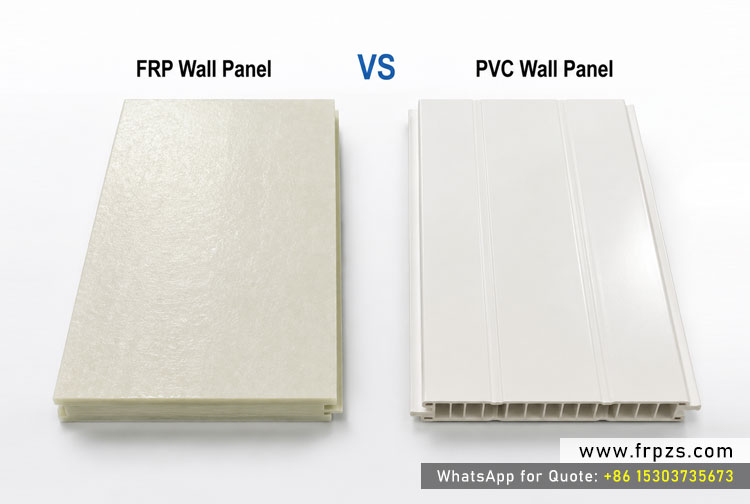
FRP vs PVC Wall Panels: Which Wall Panel Material Is Better for Industrial and Commercial Applications?
When selecting wall panel materials for industrial buildings, commercial facilities, and special environments, choosing the right material directly affects durability, maintenance costs, and long-term performance. Among the available solutions, FRP wall panels and PVC wall panels are two commonly used options. Both materials offer advantages, but they have significant differences in strength, service life, environmental resistance, and application fields.
This article provides a detailed comparison of FRP vs PVC wall panels to help engineers, architects, contractors, and industrial buyers understand which solution is more suitable for their projects.
What Are FRP Wall Panels?
FRP (Fiberglass Reinforced Plastic) wall panels are composite panels manufactured by combining high-strength fiberglass reinforcement with resin materials. Through advanced production technologies such as pultrusion and continuous molding, FRP panels achieve excellent mechanical properties and environmental resistance.
Unlike traditional materials, FRP wall panels are lightweight but extremely strong. They are widely used in industrial buildings, cold storage facilities, chemical plants, food processing factories, agricultural buildings, and infrastructure projects.
Key Features of FRP Wall Panels
- High strength-to-weight ratio
- Excellent corrosion resistance
- Moisture and chemical resistance
- Long service life with low maintenance
- Lightweight and easy installation
- Good insulation performance
- Suitable for harsh environments
What Are PVC Wall Panels?
PVC wall panels are made from polyvinyl chloride, a thermoplastic polymer widely used in residential decoration, commercial interiors, and light-duty applications.
PVC panels are popular because of their low cost, easy installation, and attractive appearance. They are commonly used for indoor walls, ceilings, bathrooms, offices, and temporary structures.
Key Features of PVC Wall Panels
- Low material cost
- Lightweight structure
- Easy cutting and installation
- Water-resistant surface
- Various colors and decorative designs
- Suitable for indoor applications
FRP vs PVC Wall Panels: Performance Comparison
| Performance | FRP Wall Panels | PVC Wall Panels |
|---|---|---|
| Strength | Very high mechanical strength due to fiberglass reinforcement | Lower strength, suitable mainly for decorative applications |
| Durability | 20-50 years service life depending on environment | Usually 10-20 years depending on usage conditions |
| Impact Resistance | Excellent impact resistance | Limited impact resistance, easier to crack |
| Corrosion Resistance | Excellent resistance to chemicals, salt, and moisture | Good water resistance but limited chemical resistance |
| Temperature Resistance | Suitable for wide temperature ranges | May deform under high temperatures |
| Maintenance | Very low maintenance requirements | Requires more frequent replacement in harsh environments |
| Application | Industrial, infrastructure, chemical, marine, agricultural projects | Residential and commercial interior decoration |
Strength and Structural Performance Comparison
One of the biggest differences between FRP and PVC wall panels is structural performance.
FRP wall panels contain continuous fiberglass reinforcement, which provides significantly higher tensile strength and stiffness. This makes FRP suitable for applications where panels need to withstand wind loads, impact forces, vibration, and long-term mechanical stress.
PVC panels are mainly designed as surface finishing materials. Although they are lightweight and easy to install, they cannot replace structural materials in demanding environments.
Corrosion Resistance: Why FRP Performs Better
In environments exposed to chemicals, moisture, salt spray, or extreme weather conditions, corrosion resistance is a critical factor.
FRP wall panels do not rust, rot, or corrode like traditional metal materials. They maintain stable performance in chemical plants, wastewater treatment facilities, coastal buildings, and industrial workshops.
PVC has good resistance to water, but prolonged exposure to strong chemicals, UV radiation, and temperature changes may reduce its performance.
FRP vs PVC Wall Panels for Industrial Applications
For industrial applications, FRP wall panels are usually the preferred choice because of their superior durability and mechanical properties.
- Food Processing Facilities: FRP panels provide hygienic surfaces and resist moisture and cleaning chemicals.
- Chemical Plants: FRP withstands corrosive environments better than PVC.
- Cold Storage Buildings: FRP provides excellent insulation compatibility and long-term stability.
- Agricultural Buildings: FRP resists humidity, fertilizer corrosion, and harsh outdoor conditions.
- Marine Applications: FRP performs well in saltwater environments.
Cost Comparison Between FRP and PVC Wall Panels
PVC wall panels usually have a lower initial purchase cost, making them attractive for budget-sensitive projects.
However, the total lifecycle cost should also be considered. FRP wall panels may have a higher initial investment, but their longer service life, lower maintenance requirements, and better durability often provide greater economic benefits over time.
For industrial projects requiring long-term reliability, FRP is often a more cost-effective solution.
Environmental Performance and Sustainability
Modern construction projects increasingly focus on sustainable materials and lifecycle performance.
FRP wall panels contribute to sustainable construction because they require fewer replacements and generate less maintenance waste throughout their service life.
PVC production involves plastic materials, and recycling can be more challenging depending on additives and processing methods.
How to Choose Between FRP and PVC Wall Panels?
The choice between FRP and PVC depends mainly on the application environment.
Choose FRP Wall Panels When:
- The project requires high strength and durability
- The environment contains chemicals or moisture
- Long service life is important
- The building requires low maintenance
- The application is industrial or outdoor
Choose PVC Wall Panels When:
- The project is mainly decorative
- Low initial cost is the priority
- The environment is clean and low-stress
- The application is indoor residential or commercial
Conclusion: FRP vs PVC Wall Panels
Both FRP and PVC wall panels have their own advantages. PVC panels are economical and suitable for general interior applications, while FRP wall panels provide superior strength, corrosion resistance, and durability for demanding environments.
For industrial facilities, infrastructure projects, chemical plants, and buildings requiring long-term performance, FRP wall panels are the better choice.
As a professional FRP composite manufacturer, Zhongsheng Composite Materials provides high-quality FRP profiles, FRP wall panels, and customized composite solutions for global customers.
Technical Summary & Engineering Data
FRP wall panels and PVC wall panels are two common solutions for industrial and commercial wall applications. This article compares FRP vs PVC wall panels in terms of strength, durability, corrosion resistance, maintenance, cost, and application environments. FRP (Fiberglass Reinforced Plastic) panels provide superior mechanical performance, excellent chemical resistance, and longer service life, making them ideal for industrial facilities, chemical plants, food processing factories, cold storage buildings, and infrastructure projects. PVC panels offer lower initial costs and are suitable for decorative and light-duty indoor applications. For projects requiring long-term durability and reliability, FRP wall panels are a more efficient and sustainable choice.
| Comparison Item | FRP Wall Panels | PVC Wall Panels |
|---|---|---|
| Material | Fiberglass reinforced plastic composite material combined with resin | Polyvinyl chloride thermoplastic material |
| Strength | High mechanical strength and excellent structural performance | Lower strength, mainly used for decorative applications |
| Durability | Long service life, typically 20-50 years depending on environment | Shorter service life, usually suitable for light-duty applications |
| Corrosion Resistance | Excellent resistance to chemicals, moisture, salt, and harsh environments | Good water resistance but limited chemical resistance |
| Impact Resistance | High impact resistance and suitable for industrial environments | More vulnerable to impact damage |
| Temperature Resistance | Maintains stable performance under wide temperature ranges | May soften or deform under high temperatures |
| Maintenance | Low maintenance requirements and reduced replacement costs | Requires more frequent maintenance in harsh conditions |
| Weight | Lightweight compared with metal wall materials | Lightweight and easy to install |
| Typical Applications | Industrial plants, chemical facilities, food factories, cold storage, marine buildings, infrastructure | Residential decoration, offices, bathrooms, commercial interiors |
| Best Choice For | Projects requiring high strength, corrosion resistance, and long service life | Projects focusing on low cost and decorative appearance |
Engineering Q&A
Q1: What is the difference between FRP wall panels and PVC wall panels?
The main difference is the material structure and performance. FRP wall panels are reinforced with fiberglass, providing higher strength, better corrosion resistance, and longer service life. PVC wall panels are made from plastic materials and are mainly used for lightweight decorative applications.
Q2: Are FRP wall panels stronger than PVC wall panels?
Yes. FRP wall panels have significantly higher mechanical strength because continuous fiberglass reinforcement improves tensile strength, stiffness, and impact resistance. PVC panels are more suitable for non-structural indoor applications.
Q3: Which is better for industrial buildings, FRP or PVC wall panels?
FRP wall panels are generally better for industrial buildings because they can withstand harsh environments, chemical exposure, moisture, and long-term mechanical stress. They are widely used in factories, warehouses, chemical plants, and infrastructure projects.
Q4: Are FRP wall panels corrosion resistant?
Yes. FRP wall panels have excellent corrosion resistance and do not rust like metal materials. They can perform reliably in environments exposed to chemicals, salt spray, humidity, and wastewater.
Q5: Are PVC wall panels cheaper than FRP wall panels?
PVC wall panels usually have a lower initial purchase cost. However, FRP wall panels often provide better long-term value because of their longer service life, lower maintenance requirements, and higher durability.
Q6: Where are FRP wall panels commonly used?
FRP wall panels are commonly used in food processing plants, cold storage facilities, chemical factories, agricultural buildings, marine structures, transportation facilities, and industrial workshops.
Q7: How long do FRP wall panels last?
Depending on environmental conditions and installation quality, FRP wall panels can provide a service life of 20 to 50 years. Their excellent resistance to corrosion and weathering makes them suitable for long-term applications.
Q8: Should I choose FRP or PVC wall panels for my project?
The choice depends on the application. PVC panels are suitable for low-cost indoor decoration, while FRP panels are recommended for industrial, outdoor, and high-performance applications requiring strength and durability.