+86 15303735673
 Jessica@frpzs.com
 Technical Data


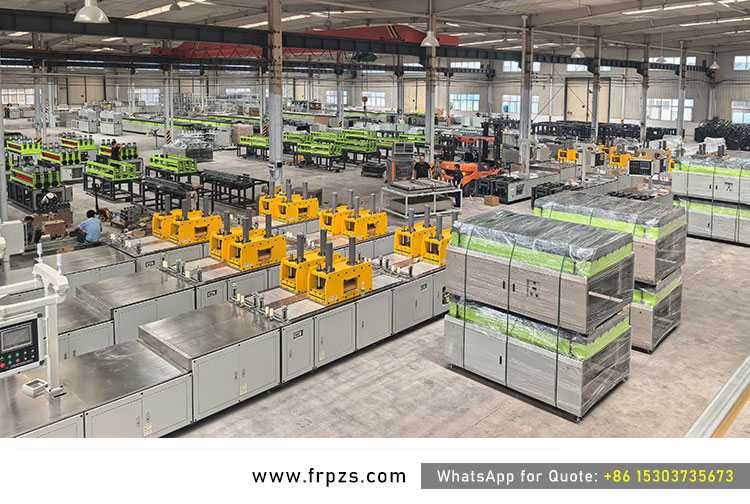
The Ultimate Guide to Heavy-Duty FRP Pultrusion Machines, Multi-Line GFRP Rebar Production Lines & Automated Composite Mesh Equipment
A Technical Analysis of High-Precision Thermo-Mechanical Control Systems, Multi-Zone Heat Configurations, and Automated Grid Weaving Innovations for Infrastructure Composites
1. Introduction to Modern Structural Composite Extrusion
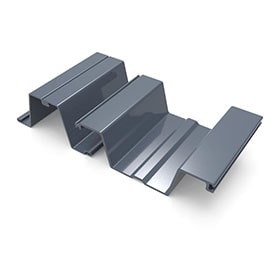
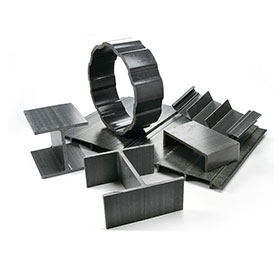
In the rapidly expanding sector of structural composite manufacturing, demand for high-strength, anti-corrosive, and lightweight materials has pushed the engineering limits of production equipment. Fiber Reinforced Polymer (FRP) and Glass Fiber Reinforced Polymer (GFRP) profiles have transitioned from specialty applications into core building components across civil engineering, marine infrastructure, and smart energy networks.
At the heart of this global transition lies the industrial-grade FRP Pultrusion Machine, high-capacity GFRP Rebar Production Lines, and next-generation FRP Mesh Production Machinery, which provide continuous molding solutions designed for round bars, structural profiles, reinforcement grids, and customized shapes.
Achieving stable chemical cross-linking and dimensional accuracy during high-volume continuous pulling requires robust mechanical infrastructure paired with state-of-the-art thermo-electrical synchronization. Today’s international market demands heavy industrial machinery that not only delivers extreme pulling forces but also integrates smart telemetry, precise multi-zone thermal regulations, and optimal footprint configurations to maximize workshop floor utilization and ROI.
2. Architectural Classifications of Heavy-Duty FRP Pultrusion Machinery
Industrial manufacturing frameworks utilize distinct pulling mechanisms tailored to profile geometries, thickness variations, and material volumes. Understanding these structural variations allows operators to select systems that match specific target throughput criteria.
Dual-Station Mechanical-Hydraulic Pultrusion Systems
The Dual-Station Mechanical-Hydraulic Pultrusion Machine represents a major leap in production efficiency by incorporating two entirely independent operating stations into a single space-saving chassis. This dual-system architecture eliminates physical interference between lines, allowing separate production settings, independent maintenance intervals, and different profile pulling on adjacent stations simultaneously.
Traction functionality is powered by highly accurate mechanical transmissions driven by specialized servo motors, ensuring ultra-smooth gantry motion, low vibration thresholds, and reduced auditory noise levels in the workshop. Gantry clamping zones rely on localized servo-hydraulic frameworks, delivering rapid response intervals, minimized thermal dispersion, and substantial energy savings compared to old-school continuous-pressure hydraulic pumps.
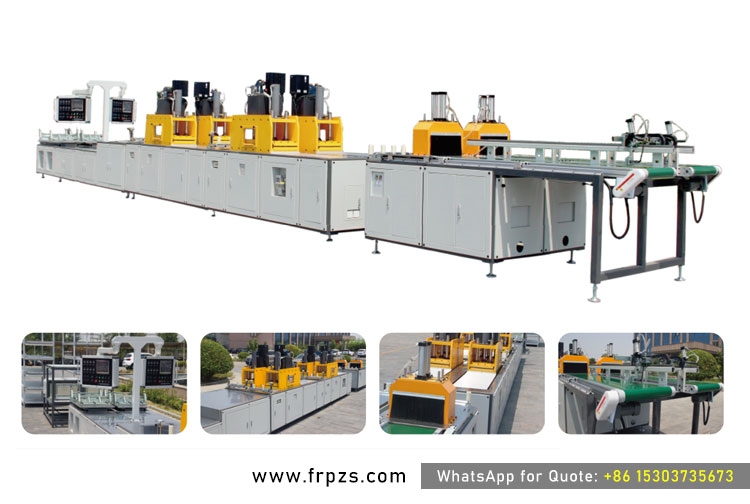
10t Dual-Station Mechanical-Hydraulic Pultrusion Machine
Single-Station Heavy Hydraulic Reciprocating Units
For large-scale thick-walled structural profiles requiring high pulling forces, heavy-duty single-station hydraulic configurations provide unparalleled mechanical stability. Driven by branded Programmable Logic Controllers (PLC), these machines coordinate pulling and clamping across complex, multi-gantry reciprocating operational routines. Manufacturers can switch between single gantry reciprocating, dual-gantry reciprocating, or alternating dual-gantry reciprocating cycles to optimize cross-sectional density and fiber orientation without stopping production lines.
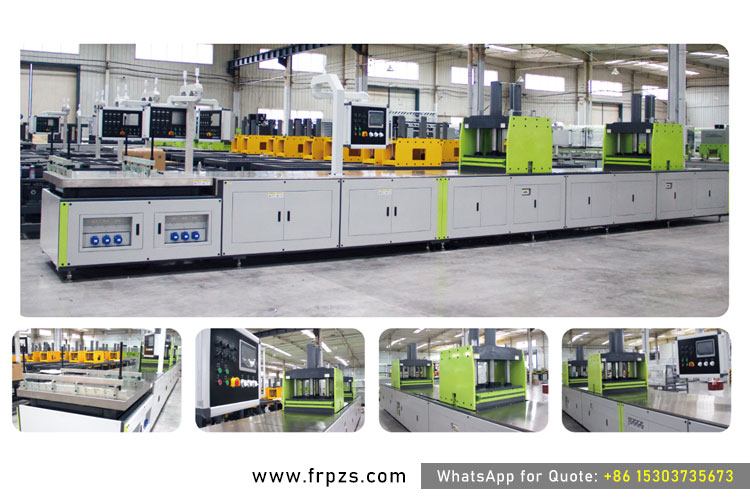
Single-Station Hydraulic Pultrusion Machine
Continuous Track-Type (Crawler) Pultrusion Equipment
When the production process demands steady, infinite linear pulling without reciprocating reset intervals, continuous track-type configurations excel. Track traction mechanisms utilize specialized high-hardness polyurethane gripping blocks (boasting a Barcol hardness rating greater than 85) to deliver reliable friction clamping without scarring delicate profiles. Driven by variable frequency inverters, these crawler mechanisms offer continuous, infinite speed scaling, ensuring highly uniform curing times inside heated die zones.
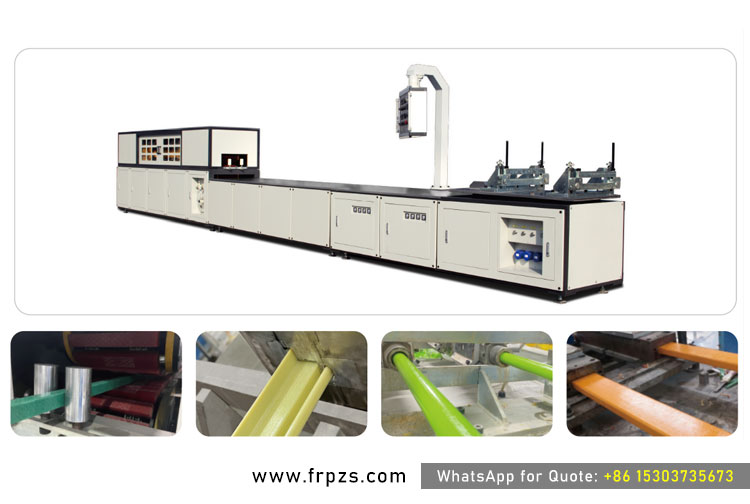
Single-Station Track-Type Pultrusion Machine 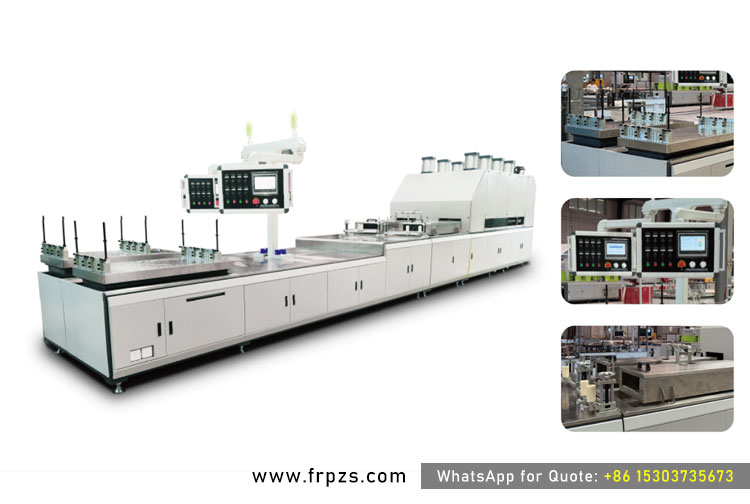
Dual-Station Track-Type Pultrusion Machine
3. Deep-Dive into Dedicated Automated FRP Mesh Equipment
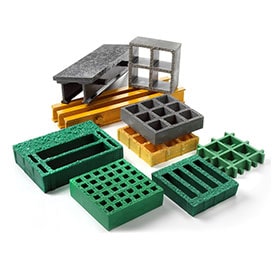
With the global ban on corrosive steel reinforcements in marine walls, mining support, and chemical floor slabs, the demand for FRP Reinforcement Mesh (also known as GFRP Wire Mesh or Fiberglass Grid) has grown exponentially. To satisfy this high-volume market, specialized automated FRP Mesh Production Lines have been engineered to replace traditional, labor-intensive manual grid binding.
Automated Weaving and Intersection Binding Technology
Modern FRP mesh equipment integrates continuous longitudinal fiber feeding with automated cross-rib intersection binding. Continuous fiberglass rovings are pulled into specialized guide dies, impregnated with high-performance resin, and then cross-woven with transverse bars at millisecond intervals. The intersections are locked together using unique mechanical cross-linking or specialized thermal binding systems, ensuring that the cured grid matrix has high shear strength and structural stability under heavy concrete pouring loads.
Flexible Grid Specification Tuning
Advanced grid machinery offers exceptional flexibility for custom structural designs. Via the master PLC HMI touch screen, operators can adjust grid aperture spacing (e.g., 50x50mm, 100x100mm, 150x150mm up to 300x300mm) without replacing expensive hardware components. The continuous mesh sheet can be automatically cut to custom lengths by an in-line traveling circular saw or rolled into compact transport rolls by a heavy-duty winding unit, drastically lowering logistics and installation costs.
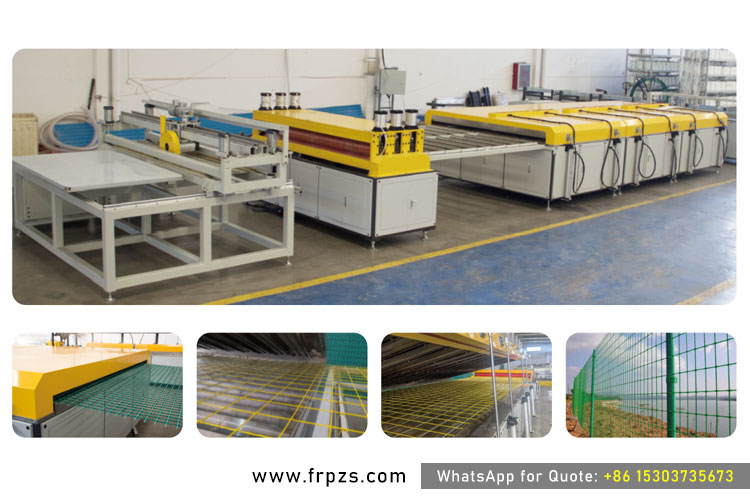
GFRP Rebar Mesh Pultrusion Production Line 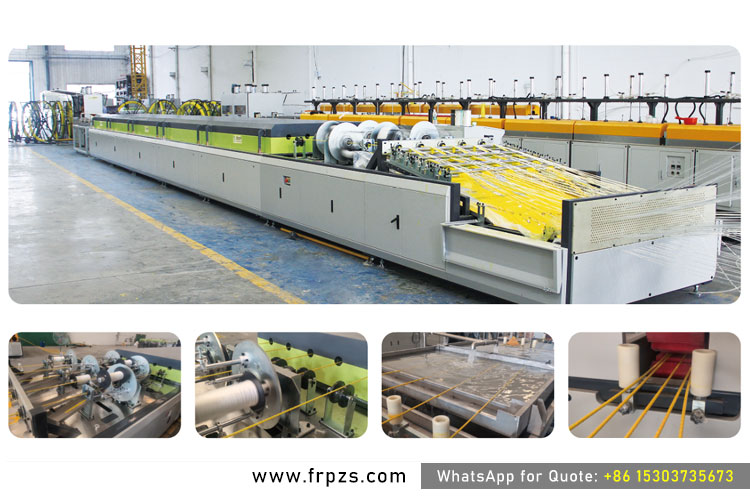
5-Line GFRP Rebar Machine
4. Comprehensive Technical Specifications Analysis
Engineered performance requires strict adherence to technical boundaries. Below are the comprehensive specifications covering standard mechanical-hydraulic pultrusion frameworks, multi-line GFRP rebar extrusion systems, and high-efficiency composite mesh plants, extracted directly from industrial design blueprints.
Table 1: Technical Parameters for Dual-Station and Heavy Hydraulic Pultrusion Equipment
| Technical Parameter / Feature | Model: ZSLY10 (Dual-Station) | Model: ZSY20 (Hydraulic) | Model: ZSY30 (Hydraulic) | Model: ZSY50 (Heavy-Duty) |
|---|---|---|---|---|
| Traction Pulling Force (kN) | 100 kN | 200 kN | 300 kN | 500 kN |
| Clamping Force Threshold (kN) | 250 kN | 490 kN | 490 kN | 640 kN |
| Traction Velocity Range | 0 – 1.2 m/min | 0 – 1.2 m/min | 0 – 1.0 m/min | 0 – 0.8 m/min |
| Mold Table Holding Zone Width | 500 mm | 900 mm | 1200 mm | 1200 mm |
| Holding Zone Length / Interval | 600-1200 mm (100 step) | 600-1200 mm (100 step) | 600-1200 mm (100 step) | 600-1200 mm (100 step) |
| Clamping Zone Dimensions (mm) | 1000 x 400 x 250 | 900 x 800 x 400 | 900 x 1000 x 400 | 900 x 1000 x 400 |
| Drive System Power Rating | 3.7kW x 4 + 2.9kW x 4 | 11 kW + 5.5 kW | 15 kW + 5.5 kW | 22 kW + 5.5 kW |
| Thermal Heating Configurations | 8 Zones x 2 Stations | 8 Zones (Single Base) | 8 Zones (Single Base) | 8 Zones (Heavy Base) |
| Temperature Control Range / Acc. | 0 - 250°C (±1°C) | 0 - 250°C (±1°C) | 0 - 250°C (±1°C) | 0 - 250°C (±1°C) |
| Mold Heating Power Allocation | 24 kW x 2 | 32 kW | 32 kW | 32 kW |
| Total Connected System Load | 76 kW | 64 kW | 64 kW | 64 kW |
| Overall Footprint Dim. (L x W x H) | 11000 x 1700 x 2200 mm | 11300 x 1140 x 2200 mm | 11300 x 1340 x 2200 mm | 12700 x 1340 x 2200 mm |
| Total Machinery Mass (Approx.) | 12.0 Tons | 9.5 Tons | 10.5 Tons | 12.0 Tons |
Table 2: Technical Parameters for Multi-Line GFRP Rebar Machine & Automated Mesh Lines
| Functional Plant Modules | Model: ZSXWJ2 (2-Line Rebar Machine) | Model: ZSXWJ5 (5-Line Rebar Machine) | Model: ZSMESH-2000 (Mesh Production Line) |
|---|---|---|---|
| Simultaneous Output Stations | 2 Parallel Lines | 5 Parallel Lines | Max 2000 mm Structural Grid Width |
| Production Specification Range | Diameter: 4 – 35 mm | Diameter: 4 – 32 mm | Grid Aperture: 50x50 mm – 300x300 mm |
| Yarn Creel Roving Capacity | 2 Levels / 300 Active Spools | 2 Levels / 300 Active Spools | 4 Levels / 500 Active Spools |
| Preheating Oven Parameters | Length: 6000 mm | Power: 6 kW | Length: 6000 mm | Power: 6 kW | Length: 8000 mm | Power: 12 kW |
| Resin Impregnation Basin Cap. | 30 Liters (Pneumatic Pressing Bar) | 40 Liters (Pneumatic Pressing Bar) | 75 Liters (Constant Temp Deep Dip) |
| Helical Winding Mechanics | 0 – 500 r/min | Power: 3 kW | 0 – 400 r/min | 1.1 kW x 5 Units | Automated Cross-Weaving Servo Drive |
| Curing Thermal Enclosures | 6 Zones | Power: 24 kW | 0-250°C | 5 Zones | Power: 9 kW x 5 | 0-250°C | 8 Zones | Power: 45 kW Flat Oven |
| Cooling Matrix Assembly | Water Cooling Matrix | Pump: 200W | Water Cooling Matrix | Pump: 200W | Forced Air + Water Spray Configuration |
| Caterpillar Traction Speed Matrix | 0 – 5000 mm/min | 1.5 kW x 2 Motors | 0 – 4000 mm/min | 1.5 kW x 2 Motors | 0 – 6000 mm/min | 3.0 kW Synchronized |
| In-line Cut-off Mechanism | 100x60 mm Window | Saw: 2.2 kW | 400x60 mm Window | Saw: 3.0 kW | Traveling Transverse Precision Shear |
| Maximum Linear Output Yield | 20 meters / minute | Up to 50 meters / minute (Combined) | 180 square meters / hour |
5. Key Engineering System Highlights
Achieving structural consistency across miles of continuous composite profiles requires integrating multiple closed-loop subsystems. Modern production systems leverage several proprietary engineering advancements:
- Closed-Loop Tension Creel Frameworks: Assembled structural steel yarn creels come equipped with localized mechanical tension regulation units. This ensures every fiberglass roving strand enters the alignment matrix under identical tension, preventing fiber deviation and eliminating structural weak points within cured profiles.
- Pneumatically Controlled Resination Reservoirs: Resin tanks use integrated pneumatic pressure bars to manage fiber wet-out. This system ensures thorough core wetting while scraping away excess chemical combinations, maintaining strict fiber-to-resin mass ratios regardless of line speeds.
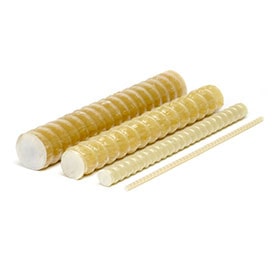
- Synchronized Helical Textured Ribbing: To produce high-bond structural FRP Rebar, helical winding devices utilize variable frequency drives that lock directly onto the main traction caterpillar line speed. This ensures perfectly uniform rib spacing across varying pulling velocities.
- Advanced Digital Thermal Profiling: Precision temperature modules monitor individual heating segments. Real-time current sensing identifies heater decay immediately, preventing localized under-curing or thermal degradation. All thermal curves can be exported via digital communication pathways directly into factory MES networks.
- Real-Time Tensile Telemetry: In-line strain-gauge load cells mounted directly onto the die station provide continuous monitoring of resistance forces. This real-time data allows operators to optimize internal mold chemistry and lubricant ratios without stopping production.
Global Procurement & Technical Engineering Support Contact
For customized mold blueprints, automated plant floor configurations, or high-volume project quotes, connect directly with our international technical sales office:
- Corporate Entity: Henan Zhongsheng Composite Material Co., Ltd.
- Global Infrastructure Gateway: www.frpzs.com
- Designated Sales Executive: Jessica Huang (Professional Sales Director)
- Inbound Corporate Email: Jessica@frpzs.com
- Direct Messaging / Global WhatsApp Hotline: +86 15303735673
- Manufacturing Headquarters: Xinxiang Industrial Zone, Henan Province, People's Republic of China
Technical Summary & Engineering Data
| Equipment Type | Model Identifier | Core Mechanical & Thermal Parameters | Production Specification & Output Capabilities |
|---|---|---|---|
| Dual-Station Pultrusion Machine | Model: ZSLY10 | Traction Force: 100 kN | Clamping Force: 250 kN | Power Rating: 26.4 kW | Heating Zones: 8 Zones x 2 Stations | Footprint: 11000 x 1700 x 2200 mm | Velocity: 0 – 1.2 m/min | Table Width: 500 mm | Total System Mass: ~12.0 Tons | Ideal for simultaneous independent profile shapes. |
| Hydraulic Reciprocating Pultrusion | Model: ZSY20 | Traction Force: 200 kN | Clamping Force: 490 kN | Power Rating: 16.5 kW | Heating Zones: 8 Zones (Single Base) | Footprint: 11300 x 1140 x 2200 mm | Velocity: 0 – 1.2 m/min | Table Width: 900 mm | Total System Mass: ~9.5 Tons | Optimized for medium-scale thick-walled profiles. |
| Heavy-Duty Hydraulic Pultrusion | Model: ZSY30 | Traction Force: 300 kN | Clamping Force: 490 kN | Power Rating: 20.5 kW | Heating Zones: 8 Zones (Single Base) | Footprint: 11300 x 1340 x 2200 mm | Velocity: 0 – 1.0 m/min | Table Width: 1200 mm | Total System Mass: ~10.5 Tons | Engineered for industrial structural composite sections. |
| Max-Capacity Heavy Hydraulic | Model: ZSY50 | Traction Force: 500 kN | Clamping Force: 640 kN | Power Rating: 27.5 kW | Heating Zones: 8 Zones (Heavy Base) | Footprint: 12700 x 1340 x 2200 mm | Velocity: 0 – 0.8 m/min | Table Width: 1200 mm | Total System Mass: ~12.0 Tons | Designed for high-resistance heavy infrastructure components. |
| 2-Line FRP Rebar Machine | Model: ZSXWJ2 | Yarn Creel: 300 Spools | Preheating Oven: 6000 mm (6 kW) | Resin Basin: 30 Liters | Curing Enclosure: 6 Zones (24 kW) | Traction: 1.5 kW x 2 | Output Station: 2 Parallel Lines | Diameter Range: 4 – 35 mm | Winding Speed: 0 – 500 r/min | Maximum Linear Yield: 20 meters / minute |
| 5-Line FRP Rebar Machine | Model: ZSXWJ5 | Yarn Creel: 300 Spools | Preheating Oven: 6000 mm (6 kW) | Resin Basin: 40 Liters | Curing Enclosure: 5 Zones (9 kW x 5) | Traction: 1.5 kW x 2 | Output Station: 5 Parallel Lines | Diameter Range: 4 – 32 mm | Winding Speed: 0 – 400 r/min x 5 | Combined Linear Yield: Up to 50 meters / minute |
| Automated Composite Mesh Line | Model: ZSMESH-2000 | Yarn Creel: 500 Spools | Preheating Oven: 8000 mm (12 kW) | Resin Basin: 75 Liters (Constant Temp) | Curing Enclosure: 45 kW Flat Oven | Grid Width: Max 2000 mm | Grid Aperture Spacing: 50x50 mm to 300x300 mm | Traction: 3.0 kW | Production Yield: 180 square meters / hour |
Engineering Q&A
Q1: What engineering systems ensure mechanical tension and structural uniformity in automated FRP rebar and mesh production?
Answer: Structural uniformity across high-volume continuous runs is achieved via three integrated sub-systems: Closed-Loop Tension Creel Frameworks that equip structural steel yarn creels with localized mechanical tension regulation units to eliminate fiber deviation; Pneumatically Controlled Resination Reservoirs with integrated pressure bars that scrape excess resin to maintain constant fiber-to-resin mass ratios; and Synchronized Helical Textured Ribbing units powered by variable frequency drives (VFD) that lock directly onto caterpillar traction speeds to guarantee perfectly uniform rib spacing.
Q2: How does multi-zone thermal profiling prevent internal structural cracking during thermosetting resin pultrusion?
Answer: Thermosetting resins like epoxy, vinyl ester, and polyester require highly precise exothermic curing pathways. Modern heavy-duty pultrusion machines utilize advanced digital thermal profiling configurations dividing the mold plates into up to 8 independent heating segments monitored by intelligent PID controllers. This layout maintains a strict temperature accuracy tolerance of ±1°C, which prevents internal core thermal cracking in thick-walled profiles and ensures total chemical cross-linking without material degradation.
Q3: What are the primary space-saving and production advantages of a Dual-Station Mechanical-Hydraulic Pultrusion Machine?
Answer: A dual-station pultrusion architecture (such as the ZSLY10 series) integrates two completely separate operating stations into a single unified chassis, cutting workshop floor footprint requirements by up to 40% while doubling output capacity. Mechanically, it utilizes independent servo-motor transmissions and localized servo-hydraulic clamping frameworks. This removes physical interference between lines, allowing operators to simultaneously manufacture entirely different profiles on adjacent stations using distinct pulling speeds, clamping setups, and heated mold profiles.
Q4: How does automated composite grid machinery adjust aperture spacing configurations?
Answer: Automated FRP mesh production lines (like the Model ZSMESH-2000) offer computerized flexibility for custom architectural grids. Instead of requiring hardware component tear-downs, operators can modify grid aperture sizing dimensions (ranging from 50x50 mm, 100x100 mm, up to 300x300 mm) directly on the fly via the master PLC HMI touch screen interface. The line automatically synchronizes the longitudinal fiber feeding with the automated cross-rib intersection servo drive and traveling precision shear.
Q5: What are the material traction boundaries and speed variations between crawler and hydraulic reciprocating units?
Answer: Crawler track-type pultrusion mechanisms provide infinite linear pulling without resetting intervals, utilizing high-hardness polyurethane gripping blocks (Barcol hardness >85) and VFDs to hit stable high-speed outputs (up to 5000–6000 mm/min on multi-line rebar or mesh variants). Conversely, heavy hydraulic reciprocating units are built for peak structural pulling force rather than high velocities, executing complex multi-gantry alternating cycles (ranging from 0 to 0.8–1.2 m/min) to deliver massive traction capacities up to 500 kN for thick-walled structural composite shapes.