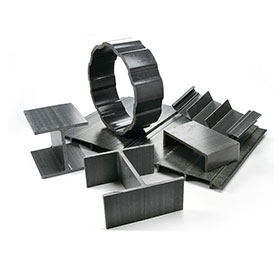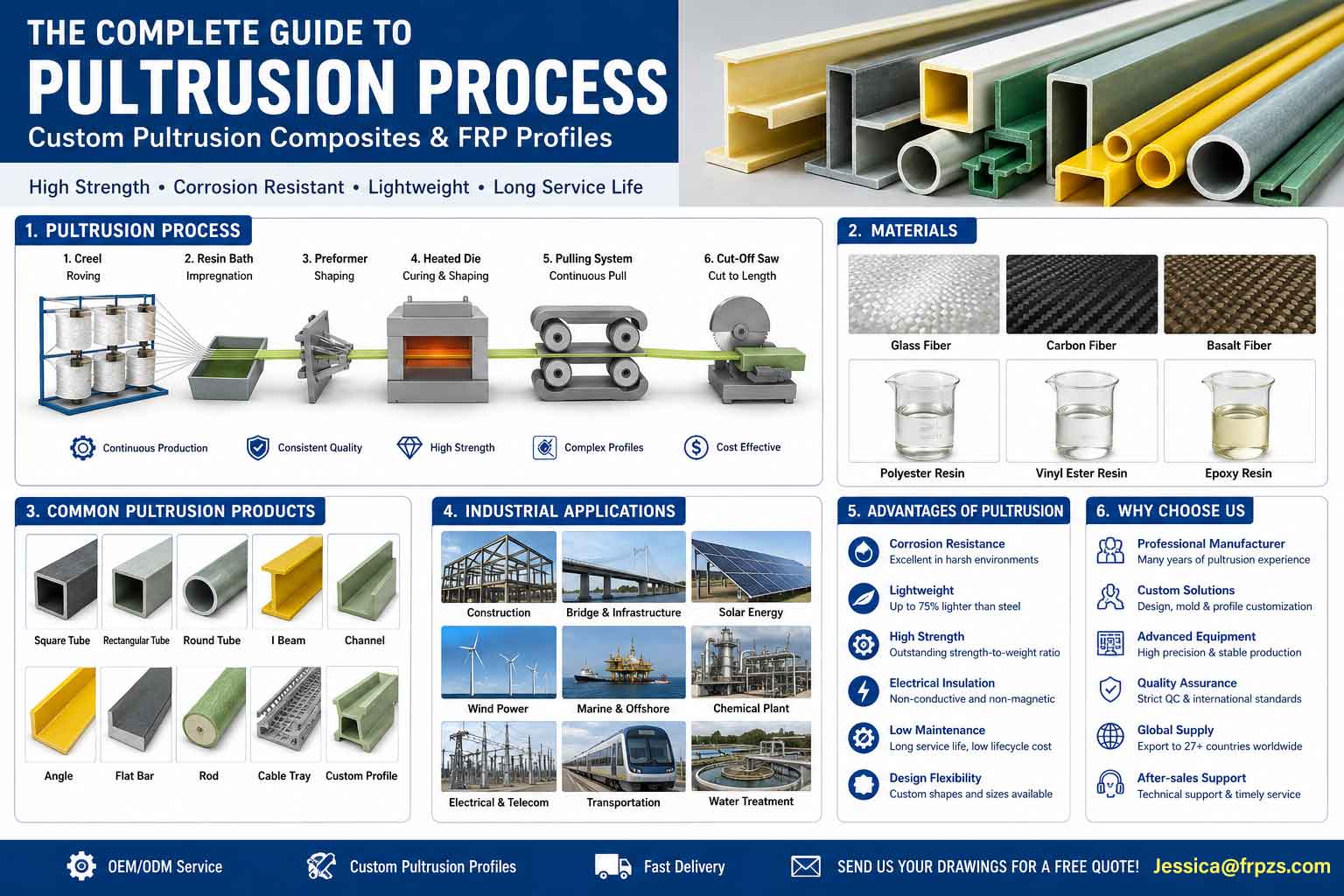
pultrusion-process-frp-composite-guide-infographic
The Complete Guide to the Pultrusion Process: Custom Pultrusion Composites and Products for Modern Industries
The pultrusion process has become one of the most important manufacturing technologies for producing high-performance composite materials. From lightweight structural profiles to corrosion-resistant industrial components, pultruded composites are replacing traditional materials such as steel, aluminum, and wood in numerous industries.
Today, engineers, architects, infrastructure developers, and industrial manufacturers increasingly rely on custom pultrusion solutions because they provide superior strength, excellent corrosion resistance, electrical insulation, dimensional stability, and an exceptionally long service life.
This comprehensive guide explains everything you need to know about the pultrusion process, including how pultrusion works, what materials are used, the different types of pultrusion products, custom pultrusion manufacturing, industry applications, engineering advantages, quality control, and supplier selection.
Complete pultrusion manufacturing process from fibers to finished FRP profiles
What is the pultrusion process?
Quick Answer:
The pultrusion process is a continuous composite manufacturing method used to produce constant cross-section fiberglass or carbon fiber reinforced polymer (FRP) profiles. Continuous reinforcing fibers are pulled through a resin system, shaped inside a heated steel die, cured under controlled temperature, and continuously pulled into finished composite products.
The word "Pultrusion" is derived from the combination of "Pull" and "Extrusion". Unlike traditional extrusion, where molten material is pushed through a die, pultrusion continuously pulls fiber reinforcements through the manufacturing system.
This production method enables manufacturers to create lightweight yet extremely strong structural components with highly consistent dimensions and excellent mechanical properties.
Engineering Insight
Because reinforcing fibers remain continuous throughout the manufacturing process, pultruded composite products achieve exceptionally high tensile strength and structural efficiency compared with many conventional materials.
Why the Pultrusion Process Is Becoming Increasingly Popular
Modern industries require materials that are stronger, lighter, and more durable while reducing maintenance costs over the entire service life of a project. Pultrusion technology successfully meets these requirements.
Compared with traditional manufacturing methods, pultrusion offers consistent quality, high production efficiency, low material waste, and outstanding repeatability.
As global demand for corrosion-resistant infrastructure and lightweight engineering materials continues to grow, pultrusion composites are being adopted across construction, transportation, electrical power, marine engineering, renewable energy, telecommunications, and chemical processing industries.
Main Advantages of the Pultrusion Process
- Continuous automated manufacturing
- High fiber volume fraction for superior strength
- Excellent dimensional consistency
- Low production waste
- Stable product quality
- Cost-effective mass production
- Suitable for complex custom profile designs
- Long service life with minimal maintenance
Did You Know?
Many pultruded composite products can provide more than 50 years of service life in harsh outdoor environments without corrosion, making them ideal for infrastructure and industrial applications.
How Does the Pultrusion Process Work?
The pultrusion manufacturing process consists of a continuous sequence of carefully controlled production stages. Each stage plays a critical role in determining the final mechanical performance and dimensional accuracy of the finished composite profile.
The basic production flow includes:
- Continuous fiber creels
- Fiber guiding and alignment
- Resin impregnation
- Preforming system
- Heated pultrusion die
- Continuous pulling system
- Automatic cutting system
Industries That Use Pultrusion Composites
Today, pultrusion products are used in nearly every major industrial sector because of their outstanding combination of strength, durability, corrosion resistance, and lightweight construction.
Common industries include:
- Construction and infrastructure
- Electrical transmission and distribution
- Renewable energy
- Rail transportation
- Marine engineering
- Chemical processing plants
- Wastewater treatment facilities
- Telecommunications
- Agriculture
- Industrial automation
Industry Trend
Global demand for pultruded composite products continues to increase as governments and private industries seek lightweight, corrosion-resistant alternatives to traditional construction materials.
Key Takeaways
- The pultrusion process is a continuous manufacturing technology for composite materials.
- Pultruded products combine lightweight construction with excellent mechanical strength.
- The technology is widely used across construction, infrastructure, transportation, and industrial sectors.
- Continuous fiber reinforcement is the key to achieving superior structural performance.
- Pultrusion enables efficient production of both standard and custom composite profiles.
The Pultrusion Process Step by Step
Quick Answer:
The pultrusion process consists of seven continuous manufacturing stages: fiber reinforcement preparation, resin impregnation, preforming, heated die curing, continuous pulling, precision cutting, and final inspection. Every stage directly affects the strength, dimensional accuracy, and long-term durability of the finished composite profile.
Unlike batch manufacturing methods, pultrusion is a continuous production technology capable of producing thousands of meters of composite profiles with identical cross-sectional dimensions. This makes it one of the most efficient manufacturing methods for structural composite products.
Step 1: Fiber Reinforcement Preparation
The process begins with continuous reinforcement fibers positioned on multiple creels. Depending on the product requirements, manufacturers may use:
- E-Glass Fiber Rovings
- ECR Glass Fiber
- Carbon Fiber
- Basalt Fiber
- Aramid Fiber
- Continuous Glass Fiber Mats
- Surface Veils
The fibers are carefully aligned before entering the production line to ensure uniform load distribution throughout the finished profile.
Engineering Insight
Fiber alignment is one of the most important factors affecting tensile strength. Poor alignment can significantly reduce the structural performance of pultruded composites.
Step 2: Resin Impregnation
After leaving the creels, the fibers pass through a resin impregnation system where every filament is thoroughly wetted with thermosetting resin.
Common resin systems include:
| Resin Type |
Main Advantages |
Typical Applications |
| Polyester Resin |
Cost-effective |
General industrial profiles |
| Vinyl Ester Resin |
Excellent corrosion resistance |
Chemical plants and marine engineering |
| Epoxy Resin |
High mechanical strength |
Aerospace and electrical insulation |
| Polyurethane Resin |
Superior toughness |
High-performance structural components |
The resin bath also contains curing agents, pigments, UV stabilizers, flame retardants, and other additives depending on customer requirements.
Step 3: Preforming System
Before entering the heated die, impregnated fibers pass through a series of preforming guides. These tools gradually shape the fiber bundle into the approximate geometry of the final profile.
The objectives of preforming include:
- Removing excess resin
- Eliminating trapped air
- Improving fiber distribution
- Reducing internal stress
- Increasing dimensional consistency
Did You Know?
Proper preforming not only improves product quality but also extends the service life of the pultrusion die by reducing unnecessary friction during production.
Step 4: Heated Pultrusion Die
The heated steel die is often considered the heart of the pultrusion process. Inside the die, the resin undergoes controlled polymerization while the composite profile is formed into its final dimensions.
Typical die temperatures range from 120°C to 180°C, depending on the selected resin system and production speed.
Inside the die, several processes occur simultaneously:
- Resin curing
- Fiber consolidation
- Cross-sectional shaping
- Dimensional stabilization
- Surface finishing
Manufacturing Note
The precision of the pultrusion die determines the dimensional tolerance of every finished profile. High-quality tooling is essential for consistent production.
Step 5: Continuous Pulling System
Once the composite has sufficiently cured, a pulling machine continuously draws the profile through the die at a precisely controlled speed.
Common pulling systems include:
- Caterpillar pullers
- Hydraulic pullers
- Servo-controlled pulling systems
Pull speed is adjusted according to profile thickness, resin chemistry, and curing characteristics. Excessive speed may result in incomplete curing, while slower speeds reduce production efficiency.
Step 6: Automatic Cutting
After leaving the pulling system, the continuous profile is cut to the required length using an automatic flying saw or precision cutting machine.
Finished products may be supplied in:
- Standard lengths
- Custom lengths
- Kit components
- OEM assemblies
Step 7: Quality Inspection
Every finished pultruded product should undergo quality inspection before packaging and shipment.
Typical inspection items include:
- Dimensional tolerance
- Straightness
- Surface finish
- Fiber distribution
- Mechanical properties
- Visual defects
Critical Process Parameters
| Parameter |
Typical Range |
Importance |
| Die Temperature |
120–180°C |
Controls resin curing |
| Pull Speed |
0.2–2.0 m/min |
Affects curing quality |
| Fiber Content |
55–75% |
Determines strength |
| Curing Time |
Depends on profile size |
Ensures complete polymerization |
Key Takeaways
- The pultrusion process is a highly controlled continuous manufacturing technology.
- Fiber alignment, resin impregnation, and die temperature are the three most critical factors affecting product quality.
- Modern pultrusion enables high-volume production with excellent dimensional consistency.
- Quality control throughout the production process ensures reliable composite performance.
- Optimized process parameters result in stronger, lighter, and more durable pultrusion products.
What Are Pultrusion Composites?
Quick Answer:
Pultrusion composites are fiber-reinforced polymer (FRP) materials manufactured through the continuous pultrusion process. They combine high-strength reinforcing fibers with thermosetting resin systems to produce lightweight structural components with excellent mechanical performance, corrosion resistance, and long-term durability.
Unlike conventional construction materials, pultrusion composites are engineered materials whose mechanical properties can be tailored by selecting different reinforcement fibers, resin systems, and manufacturing parameters.
Because of their excellent strength-to-weight ratio and outstanding resistance to corrosion, pultruded composite materials are increasingly replacing steel, aluminum, and timber in infrastructure, transportation, electrical, marine, and industrial applications.
Engineering Insight
Pultrusion composites are not simply plastic materials reinforced with fibers. They are highly engineered structural materials whose performance depends on fiber orientation, resin chemistry, fiber volume fraction, and manufacturing precision.
Main Components of Pultrusion Composites
Every pultruded composite profile consists of two primary components:
1. Reinforcement Fibers
The reinforcement fibers provide the majority of the structural strength and stiffness.
Common reinforcement materials include:
- Glass Fiber (E-Glass)
- ECR Glass Fiber
- Carbon Fiber
- Basalt Fiber
- Aramid Fiber (Kevlar)
2. Thermosetting Resin
The resin binds the fibers together, transfers loads between individual fibers, and protects the reinforcement from moisture, chemicals, UV radiation, and environmental damage.
Common resin systems include:
- Unsaturated Polyester Resin
- Vinyl Ester Resin
- Epoxy Resin
- Polyurethane Resin
How Fiber Reinforcement Determines Performance
Fiber reinforcement is the backbone of every pultruded composite product. Since fibers carry most of the applied load, their orientation and quality directly determine mechanical performance.
| Fiber Type |
Main Characteristics |
Typical Applications |
| Glass Fiber |
High strength, economical |
Construction, electrical, infrastructure |
| Carbon Fiber |
Extremely high stiffness |
Aerospace, defense, robotics |
| Basalt Fiber |
Excellent chemical resistance |
Marine and industrial equipment |
| Aramid Fiber |
Impact resistance |
Protective structures |
Did You Know?
More than 80% of commercial pultrusion products worldwide are manufactured using glass fiber because it provides the best balance between mechanical performance and production cost.
Why Resin Selection Matters
Although reinforcing fibers provide structural strength, the resin system determines many environmental and durability characteristics of the finished composite.
Different resin systems provide different advantages:
- Excellent corrosion resistance
- Superior UV resistance
- Electrical insulation
- Fire retardancy
- Chemical resistance
- Weather resistance
- Surface finish quality
Choosing the correct resin is often as important as selecting the appropriate fiber reinforcement.
Mechanical Properties of Pultrusion Composites
Pultruded composite materials offer an excellent combination of mechanical performance and lightweight construction.
| Property |
Pultrusion Composite |
Structural Steel |
| Density |
1.8–2.0 g/cm³ |
7.85 g/cm³ |
| Corrosion Resistance |
Excellent |
Poor without protection |
| Electrical Conductivity |
Non-conductive |
Conductive |
| Magnetic Property |
Non-magnetic |
Magnetic |
| Maintenance |
Very Low |
High in corrosive environments |
Engineering Insight
Instead of comparing only tensile strength, engineers often evaluate pultrusion composites based on their strength-to-weight ratio, lifecycle cost, and environmental durability.
Advantages of Pultrusion Composites
- High strength-to-weight ratio
- Outstanding corrosion resistance
- Excellent fatigue performance
- Electrical insulation
- Thermal insulation
- Low maintenance requirements
- Excellent dimensional stability
- Long service life
- Custom profile capability
- Consistent manufacturing quality
Key Takeaways
- Pultrusion composites combine continuous reinforcing fibers with high-performance thermosetting resins.
- Fiber selection determines structural strength and stiffness.
- Resin selection determines environmental durability and corrosion resistance.
- Glass fiber remains the most widely used reinforcement for commercial pultrusion products.
- Pultruded composites offer superior lifecycle performance compared with many traditional materials.
Materials Used in the Pultrusion Process
Quick Answer:
The performance of pultruded composite products depends largely on the combination of reinforcing fibers and thermosetting resin systems. Selecting the right materials determines the strength, stiffness, corrosion resistance, fire performance, electrical insulation, and service life of the finished product.
Modern pultrusion technology allows manufacturers to combine different reinforcement materials with specialized resin systems to meet the requirements of construction, infrastructure, transportation, electrical power, marine engineering, and industrial applications.
Engineering Insight
The same pultrusion production line can manufacture completely different products simply by changing the reinforcement architecture, resin formulation, and pultrusion die.
Glass Fiber Reinforcement
Glass fiber is the most widely used reinforcement material in the pultrusion industry because it offers an excellent balance between strength, durability, and cost.
Common types include:
- E-Glass Fiber
- ECR Glass Fiber
- Direct Rovings
- Continuous Strand Mats
- Surface Veils
Glass fiber reinforced pultruded products are commonly used for structural profiles, cable trays, ladders, handrails, cooling towers, bridges, and utility infrastructure.
Carbon Fiber Reinforcement
Carbon fiber provides significantly higher stiffness and lower weight than glass fiber, making it ideal for demanding engineering applications.
Typical applications include:
- Aerospace structures
- Robotics
- Wind energy components
- High-performance industrial equipment
- Precision engineering systems
Although carbon fiber pultrusion products are more expensive, they deliver exceptional mechanical performance where weight reduction is critical.
Basalt Fiber Reinforcement
Basalt fiber has gained popularity as an environmentally friendly reinforcement material. It offers excellent resistance to heat, chemicals, and corrosion while providing mechanical properties between glass fiber and carbon fiber.
Basalt fiber pultrusion products are increasingly used in:
- Marine engineering
- Chemical processing plants
- Infrastructure exposed to aggressive environments
Did You Know?
Basalt fiber is produced from natural volcanic rock and is considered a sustainable reinforcement material for many composite applications.
Thermosetting Resin Systems
The resin system binds the reinforcing fibers together and determines many of the environmental performance characteristics of pultruded composites.
| Resin |
Main Advantages |
Typical Applications |
| Polyester |
Economical, easy processing |
General FRP profiles |
| Vinyl Ester |
Superior corrosion resistance |
Chemical plants, marine structures |
| Epoxy |
High strength and adhesion |
Electrical insulation, aerospace |
| Polyurethane |
Excellent toughness and fatigue resistance |
Structural profiles and transportation |
How Material Selection Affects Performance
Every application has unique performance requirements. Selecting the proper fiber and resin combination ensures that the finished pultruded product performs reliably throughout its intended service life.
| Performance Requirement |
Recommended Material |
| Corrosion Resistance |
Glass Fiber + Vinyl Ester |
| High Strength |
Carbon Fiber + Epoxy |
| Electrical Insulation |
Glass Fiber + Polyester |
| Marine Environment |
Glass Fiber + Vinyl Ester |
| Lightweight Structure |
Carbon Fiber + Epoxy |
Material Standards
High-quality pultrusion manufacturers follow internationally recognized standards to ensure material consistency and product reliability.
- ASTM Standards
- ISO Standards
- EN Standards
- CSA Standards
- Customer-specific engineering specifications
Key Takeaways
- Material selection is the foundation of pultruded composite performance.
- Glass fiber remains the most commonly used reinforcement for commercial applications.
- Carbon fiber provides superior stiffness for high-performance structures.
- Basalt fiber offers excellent corrosion and heat resistance.
- The choice of resin system directly affects durability, chemical resistance, and long-term service life.
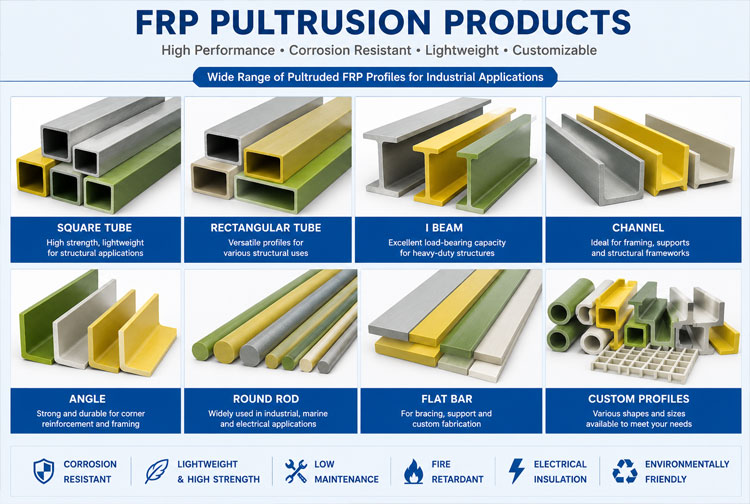
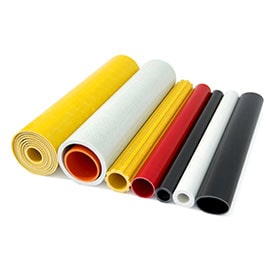
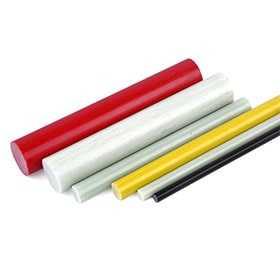
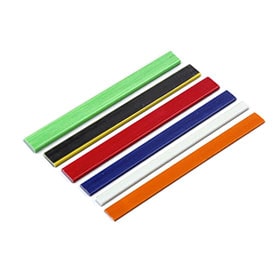
Main FRP pultrusion product types for industrial applications
Pultrusion Products: Types, Features, and Applications
Quick Answer:
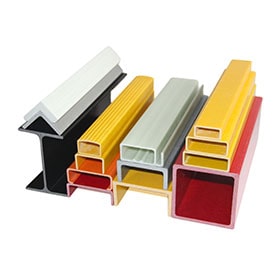
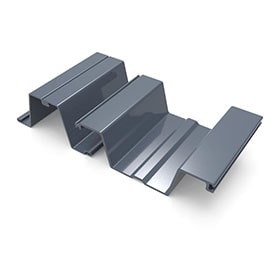
Pultrusion products are continuous fiber reinforced composite profiles manufactured using the pultrusion process. They include structural shapes such as square tubes, rectangular tubes, round tubes, I beams, H beams, channels, angles, flat bars, rods, ladder rails, cable trays, handrails, and many custom composite profiles for industrial applications.
Today, pultruded composite products are widely used as lightweight alternatives to steel, aluminum, and wood. Because every profile is manufactured through a continuous production process, pultrusion products offer consistent quality, excellent mechanical properties, corrosion resistance, electrical insulation, and minimal maintenance requirements.
Engineering Insight
One of the greatest advantages of pultrusion is the ability to manufacture complex structural profiles with identical cross-sections over virtually unlimited lengths while maintaining tight dimensional tolerances.
Common Types of Pultrusion Products
Pultrusion technology supports hundreds of profile designs. The most common products include structural components, electrical insulation products, industrial platforms, transportation components, and custom-engineered composite profiles.
FRP Square Tube
FRP square tubes are among the most popular pultruded products. Their high strength-to-weight ratio and corrosion resistance make them suitable for structural frameworks, equipment supports, fencing systems, and architectural applications.
- Excellent structural stability
- Lightweight compared with steel
- Non-corrosive
- Electrical insulation
- Low maintenance
FRP Rectangular Tube
Rectangular pultruded tubes provide greater bending resistance in one direction and are commonly used for equipment frames, bridge structures, walkways, platforms, and transportation systems.
FRP Round Tube
Pultruded round tubes are frequently used in ladders, handrails, flag poles, tool handles, agricultural equipment, and industrial machinery.
Advantages include:
- Uniform strength distribution
- Smooth surface finish
- Excellent weather resistance
- Easy machining
Structural Pultrusion Profiles
Structural pultrusion products are specifically designed for load-bearing applications where high mechanical strength and long service life are required.
| Profile |
Typical Application |
| FRP I Beam |
Bridge structures, platforms, buildings |
| FRP H Beam |
Heavy structural support systems |
| FRP Channel |
Equipment frames, cable supports |
| FRP Angle |
Bracing systems, corner reinforcement |
| FRP Flat Bar |
Electrical insulation, machine components |
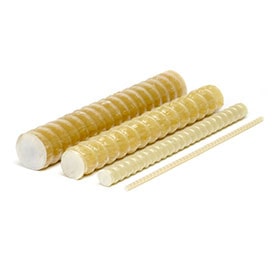
| FRP Rod |
Support rods, reinforcement, tooling |
Did You Know?
Pultruded structural profiles are increasingly replacing galvanized steel in wastewater treatment plants and chemical facilities because they eliminate corrosion-related maintenance.
Electrical and Utility Pultrusion Products
Because fiberglass composites are electrically non-conductive, pultrusion products are widely used in electrical and utility industries.
Typical products include:
- FRP Cable Trays
- Cable Ladder Systems
- Cross Arms for Utility Poles
- Electrical Insulating Profiles
- Transformer Components
- Switchgear Structural Parts
Industrial Pultrusion Products
Industrial facilities often require materials capable of withstanding moisture, chemicals, UV exposure, and aggressive environments.
Common industrial pultrusion products include:
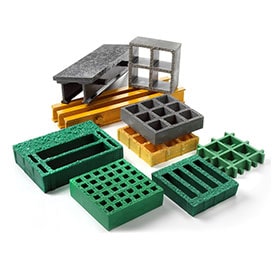
- FRP Grating Support Beams
- Cooling Tower Components
- Chemical Plant Structures
- Pipe Supports
- Equipment Platforms
- Safety Handrail Systems
- Walkway Structures
Industry Trend
Many industrial plants now specify FRP pultrusion products during the design phase because the lower maintenance costs significantly reduce total lifecycle expenses.
Advantages of Pultruded Products
- High strength-to-weight ratio
- Excellent corrosion resistance
- Electrical insulation
- UV resistance
- Fire-retardant options available
- Long service life
- Consistent manufacturing quality
- Easy fabrication and installation
- Low maintenance costs
- Environmentally friendly throughout their service life
Key Takeaways
- Pultrusion products include structural profiles, electrical components, industrial systems, and custom composite solutions.
- FRP square tubes, channels, I beams, and cable trays are among the most widely used pultruded products.
- Pultruded profiles provide excellent corrosion resistance and long-term durability.
- Industrial users increasingly replace steel with pultruded composites to reduce maintenance costs.
- The versatility of pultrusion technology enables manufacturers to produce hundreds of profile configurations.
Custom Pultrusion Solutions for Specialized Engineering Projects
Quick Answer:
Custom pultrusion is the process of designing and manufacturing composite profiles according to specific customer requirements, including custom cross-sections, dimensions, materials, colors, mechanical properties, and surface finishes. It enables engineers to replace traditional materials with optimized composite solutions tailored to each project.
Standard pultruded profiles meet the needs of many applications, but modern engineering projects often require unique shapes, higher mechanical performance, tighter tolerances, or special environmental resistance. Custom pultrusion allows manufacturers to develop profiles that precisely match project specifications while maintaining the advantages of continuous composite manufacturing.
Engineering Insight
One custom pultruded profile can often replace multiple fabricated steel components, reducing assembly time, lowering weight, and minimizing maintenance throughout the product's service life.
What Can Be Customized?
Professional pultrusion manufacturers can customize nearly every aspect of a composite profile.
- Cross-sectional shape
- Profile dimensions
- Wall thickness
- Fiber architecture
- Resin system
- Surface finish
- Color
- Fire-retardant performance
- UV resistance
- Electrical insulation properties
- Mechanical strength
- Cut length
- Machining and drilling
- Assembly components
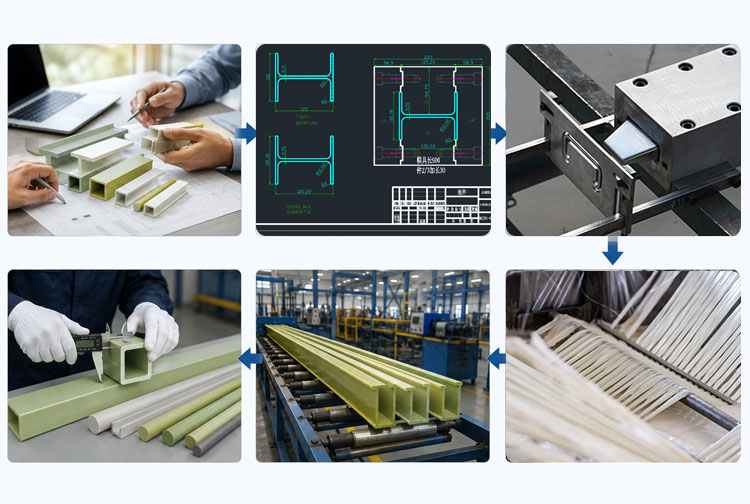
OEM and custom pultrusion solution workflow
Custom Pultrusion Design Process
Developing a custom pultruded profile follows a structured engineering workflow to ensure that the final product meets both functional and manufacturing requirements.
- Project consultation
- Application analysis
- Technical drawing review
- Material selection
- Cross-section optimization
- Pultrusion die design
- Prototype production
- Mechanical testing
- Customer approval
- Mass production
Did You Know?
Many successful custom pultrusion projects begin with only a simple CAD drawing or a sample part. Experienced manufacturers can optimize the profile for both structural performance and production efficiency.
Pultrusion Mold Design
The pultrusion die is one of the most important components in custom profile manufacturing. A precision-designed die ensures dimensional accuracy, smooth surface quality, and stable production over long manufacturing runs.
Key design considerations include:
- Profile geometry
- Material shrinkage
- Resin curing characteristics
- Fiber distribution
- Temperature control
- Production speed
- Dimensional tolerance
OEM and ODM Pultrusion Manufacturing
Many customers require confidential manufacturing services for proprietary products. Professional pultrusion factories commonly provide both OEM and ODM solutions.
| Manufacturing Model |
Description |
| OEM |
Manufacturing according to customer drawings and specifications |
| ODM |
Design assistance and complete product development |
These services help customers accelerate product development while reducing tooling investment and manufacturing risks.
Surface Finish Options
Different applications require different surface treatments to improve aesthetics or functional performance.
- Smooth surface
- Textured surface
- Anti-slip finish
- UV-resistant coating
- Polyurethane protective layer
- Paint-ready finish
- Color integrated resin system
Secondary Processing Services
After pultrusion, many profiles undergo additional machining operations before final assembly.
Typical secondary processing includes:
- CNC machining
- Drilling
- Milling
- Cutting
- Threading
- Bonding
- Mechanical assembly
- Custom packaging
Manufacturing Note
Performing secondary machining at the factory improves dimensional accuracy, reduces installation time, and ensures consistent product quality.
Industries Using Custom Pultrusion
Custom pultruded profiles are widely used across numerous industries requiring specialized engineering solutions.
- Construction
- Bridge engineering
- Solar energy systems
- Wind power
- Electrical transmission
- Rail transportation
- Marine engineering
- Chemical processing
- Water treatment
- Agricultural equipment
- Telecommunications
- Industrial automation
How to Choose a Custom Pultrusion Manufacturer
Selecting an experienced manufacturer is essential for ensuring consistent product quality and long-term project success.
When evaluating suppliers, consider:
- Engineering experience
- Custom mold design capability
- Production capacity
- Quality management system
- Material traceability
- Mechanical testing capability
- International certifications
- Export experience
- Technical support
- After-sales service
Industry Trend
As infrastructure projects become more specialized, demand for custom pultrusion solutions continues to grow faster than demand for standard composite profiles.
Key Takeaways
- Custom pultrusion provides engineered composite solutions for specialized applications.
- Profile geometry, material selection, and mold design determine product performance.
- OEM and ODM services help accelerate product development.
- Professional secondary processing improves installation efficiency.
- Choosing an experienced pultrusion manufacturer is critical for quality and project success.
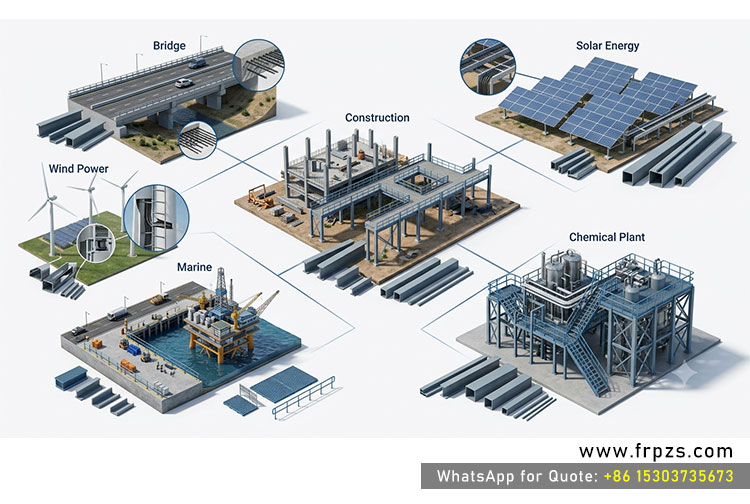
Key industries using pultruded composite profiles
Applications of Pultrusion Products Across Modern Industries
Quick Answer:
Pultrusion products are widely used in construction, infrastructure, electrical power, renewable energy, marine engineering, transportation, chemical processing, telecommunications, and industrial manufacturing. Their lightweight design, corrosion resistance, electrical insulation, and long service life make pultruded composites an ideal alternative to steel, aluminum, and wood.
As industries demand stronger, lighter, and more durable materials, pultruded composite profiles have become essential components in modern engineering projects. Continuous improvements in resin technology, fiber reinforcement, and manufacturing precision have expanded the range of applications far beyond traditional fiberglass products.
Engineering Insight
Rather than replacing traditional materials in every application, pultruded composites deliver the greatest value where corrosion resistance, electrical insulation, low maintenance, and lightweight construction are critical design requirements.
Construction and Building Industry
The construction industry is one of the largest users of pultrusion products. Engineers increasingly specify FRP structural profiles because they reduce maintenance costs while improving durability in aggressive environments.
Typical construction applications include:
- Building structural frames
- Architectural façade support systems
- Pedestrian bridges
- Roof support structures
- Safety handrails
- Stair systems
- Access platforms
- Equipment support structures
Bridge and Infrastructure Projects
Infrastructure projects require materials capable of withstanding decades of environmental exposure. Pultruded composite profiles provide excellent corrosion resistance in bridges, highways, tunnels, and public infrastructure.
Common infrastructure products include:
- Bridge decks
- Bridge maintenance walkways
- Cable management systems
- Expansion joint supports
- Inspection platforms
- Structural reinforcement members
Did You Know?
Many bridge maintenance costs are directly related to steel corrosion. Pultruded FRP structural components help significantly reduce long-term repair and replacement expenses.
Electrical Power and Utility Industry
Because fiberglass composites are non-conductive and non-magnetic, pultrusion products are widely used throughout electrical transmission and distribution systems.
- Cross arms
- Cable trays
- Cable ladders
- Insulating channels
- Transformer supports
- Switchgear structures
- Electrical safety barriers
Unlike steel, pultruded composite profiles eliminate electrical conductivity and reduce maintenance in outdoor utility environments.
Solar Energy Systems
The rapid expansion of renewable energy has created significant demand for lightweight composite structural components. Pultrusion products are widely used in photovoltaic mounting systems because they combine corrosion resistance with excellent mechanical performance.
Typical solar applications include:
- PV module support structures
- Solar tracker components
- Cable management systems
- Walkways for solar farms
- Maintenance platforms
Wind Energy Industry
Wind power projects require materials capable of resisting harsh environmental conditions while minimizing structural weight.
Pultruded composites are commonly used for:
- Turbine internal structures
- Cable protection systems
- Maintenance platforms
- Equipment supports
- Safety access systems
Industry Trend
Renewable energy projects increasingly specify pultruded composite components because they offer long service life with minimal maintenance in outdoor environments.
Chemical Processing Plants
Chemical facilities expose structural materials to acids, alkalis, salts, and aggressive chemicals. Pultruded composites manufactured with vinyl ester resin offer exceptional chemical resistance.
Typical applications include:
- Chemical plant walkways
- Pipe support systems
- Equipment platforms
- Safety guardrails
- Structural support frames
- Corrosion-resistant access systems
Marine Engineering
Marine environments accelerate corrosion in conventional steel structures. Pultrusion products provide an effective solution because fiberglass composites are immune to rust and highly resistant to saltwater exposure.
Marine applications include:
- Docks
- Piers
- Floating platforms
- Harbor structures
- Marine walkways
- Offshore maintenance systems
Key Takeaways
- Pultrusion products serve a wide range of industries, from construction to renewable energy.
- Corrosion resistance makes pultruded composites especially valuable in marine and chemical environments.
- Electrical insulation is a major advantage for utility and power applications.
- Lightweight structures reduce installation time and transportation costs.
- Long service life helps lower total lifecycle costs across infrastructure projects.
Wastewater Treatment Facilities
Wastewater treatment plants operate in highly corrosive environments where steel structures require frequent maintenance. Pultruded FRP products provide a long-lasting alternative that resists moisture, chemicals, and biological corrosion.
Typical applications include:
- Operating platforms
- Safety handrails
- Walkways
- Pump support structures
- Cable tray systems
- Maintenance access ladders
Engineering Insight
Unlike galvanized steel, pultruded composite profiles do not require repainting or corrosion protection throughout their service life, significantly reducing maintenance costs.
Oil and Gas Industry
The oil and gas industry requires structural materials capable of performing under severe environmental conditions, including offshore platforms, refineries, and petrochemical plants.
Pultrusion products are commonly used for:
- Offshore platforms
- Pipe support systems
- Safety barriers
- Access platforms
- Cable management systems
- Equipment support frames
Because fiberglass composites are corrosion resistant and electrically non-conductive, they provide significant safety advantages in hazardous environments.
Rail Transportation
Modern railway systems require lightweight, durable materials that minimize maintenance while improving passenger safety.
Pultruded composite products are increasingly used in:
- Cable ducts
- Equipment cabinets
- Station platforms
- Pedestrian bridges
- Signal support structures
- Protective barriers
Telecommunications Infrastructure
The telecommunications industry benefits from the non-conductive and non-magnetic properties of fiberglass pultrusion products.
Typical applications include:
- Antenna support structures
- Communication towers
- Cable management systems
- Equipment mounting brackets
- Outdoor equipment enclosures
Agriculture and Livestock Facilities
Agricultural environments expose structural materials to fertilizers, moisture, and corrosive chemicals. Pultruded composite profiles offer outstanding durability with minimal maintenance.
Typical applications include:
- Greenhouse structures
- Animal housing systems
- Irrigation equipment
- Fence posts
- Feed storage platforms
- Ventilation support frames
Did You Know?
Fiberglass pultrusion products do not rot, rust, or attract insects, making them an excellent replacement for timber in agricultural applications.
Mining Industry
Mining operations demand materials capable of resisting abrasion, moisture, chemicals, and harsh operating conditions.
Pultruded composite products are used for:
- Maintenance walkways
- Underground cable trays
- Ventilation structures
- Equipment platforms
- Safety guardrails
Cooling Towers and HVAC Systems
Cooling towers operate continuously in humid environments where conventional steel rapidly corrodes.
Pultrusion products provide excellent long-term performance for:
- Cooling tower structural members
- Fan support systems
- Maintenance platforms
- Water distribution structures
- HVAC equipment frames
Food and Beverage Processing
Food production facilities require materials that are corrosion resistant, easy to clean, and suitable for hygienic environments.
Pultruded composite profiles are used in:
- Processing platforms
- Equipment supports
- Walkways
- Drainage systems
- Machine guards
Why Engineers Choose Pultrusion Products
| Engineering Requirement |
Pultrusion Advantage |
| Corrosion Resistance |
No rust in aggressive environments |
| Weight Reduction |
Approximately 75% lighter than steel |
| Electrical Safety |
Non-conductive and non-magnetic |
| Maintenance |
Minimal maintenance throughout service life |
| Installation |
Easy transportation and fast assembly |
| Lifecycle Cost |
Lower total ownership cost |
Industry Trend
Across multiple industries, engineers are shifting from material-cost comparisons to lifecycle-cost analysis. Although pultruded composites may have a higher initial material cost in some applications, their long service life and reduced maintenance often provide a lower total cost of ownership.
Key Takeaways
- Pultrusion products are suitable for nearly every industry requiring corrosion-resistant structural materials.
- Infrastructure, energy, marine, wastewater, mining, and telecommunications are among the fastest-growing application sectors.
- Excellent durability and low maintenance contribute to lower lifecycle costs.
- Fiberglass pultrusion products help improve safety by providing electrical insulation and corrosion resistance.
- The versatility of pultrusion technology continues to expand with new composite materials and engineering designs.
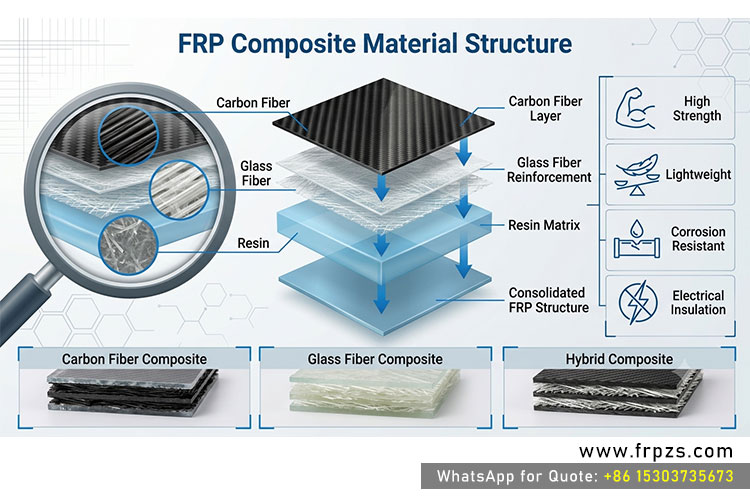
Fiber reinforced polymer material composition diagram
Advantages of Pultrusion Compared with Traditional Materials
Quick Answer:
Pultruded composite materials provide numerous advantages over steel, aluminum, and wood. They are significantly lighter, corrosion resistant, electrically non-conductive, non-magnetic, and require very little maintenance throughout their service life. These benefits make pultrusion products an ideal choice for modern infrastructure and industrial applications.
When selecting structural materials, engineers no longer evaluate products based solely on initial purchase price. Today's projects increasingly focus on total lifecycle performance, maintenance requirements, environmental durability, and installation efficiency.
Pultruded composites outperform many conventional materials in environments where corrosion, moisture, chemicals, or electrical insulation are important considerations.
Engineering Insight
In many infrastructure projects, maintenance costs over a 30 to 50-year service life exceed the initial material cost. Choosing corrosion-resistant pultruded composites can significantly reduce long-term ownership expenses.
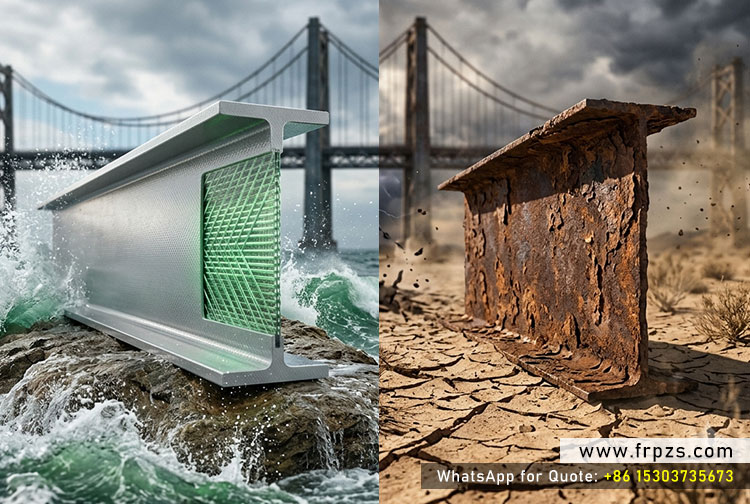
FRP vs Steel comparison for structural engineering applications
Pultrusion vs Steel
| Property |
Pultruded Composite |
Steel |
| Weight |
Approximately 75% lighter |
Heavy |
| Corrosion Resistance |
Excellent |
Requires protective coatings |
| Electrical Conductivity |
Non-conductive |
Conductive |
| Magnetic Properties |
Non-magnetic |
Magnetic |
| Maintenance |
Very Low |
Regular inspection and repainting |
| Installation |
Easy handling |
Requires lifting equipment |
| Expected Service Life |
50+ years |
Depends on corrosion protection |
Why Replace Steel with Pultruded Composites?
Steel remains an excellent structural material for many applications, but in corrosive environments it requires regular maintenance to prevent rust and structural degradation.
Pultruded composite profiles eliminate these issues by providing:
- Excellent corrosion resistance
- No rust formation
- Reduced maintenance costs
- Longer service intervals
- Improved worker safety
- Lower transportation costs
Did You Know?
In coastal environments, corrosion protection accounts for a significant portion of steel maintenance costs. Pultruded fiberglass profiles eliminate this recurring expense.
Pultrusion vs Aluminum
| Property |
Pultruded Composite |
Aluminum |
| Weight |
Lightweight |
Lightweight |
| Electrical Conductivity |
Non-conductive |
Highly conductive |
| Thermal Conductivity |
Low |
High |
| Corrosion Resistance |
Excellent |
Good |
| Strength-to-Weight Ratio |
Excellent |
Very Good |
| Electromagnetic Transparency |
Excellent |
Poor |
For electrical equipment, communication towers, substations, and radar systems, pultruded composites provide significant advantages because they do not interfere with electromagnetic signals.
Pultrusion vs Wood
| Property |
Pultruded Composite |
Wood |
| Rot Resistance |
Excellent |
Poor |
| Moisture Absorption |
Very Low |
High |
| Insect Resistance |
Excellent |
Susceptible |
| Dimensional Stability |
Excellent |
May warp or crack |
| Maintenance |
Minimal |
Frequent treatment required |
In outdoor structures such as boardwalks, fencing systems, pedestrian bridges, and agricultural facilities, pultruded composites offer a much longer service life than untreated timber.
Main Benefits of Pultrusion Products
- Lightweight yet structurally strong
- Outstanding corrosion resistance
- Excellent fatigue performance
- Electrical insulation
- Non-magnetic properties
- Low thermal conductivity
- Weather and UV resistance
- Long service life
- Minimal maintenance
- Easy fabrication and installation
- Consistent manufacturing quality
- Lower lifecycle costs
Industry Trend
Many engineering specifications now prioritize lifecycle value instead of initial purchase price. Pultruded composites continue gaining market share because they reduce maintenance while improving long-term reliability.
Key Takeaways
- Pultruded composites outperform traditional materials in corrosive and electrically sensitive environments.
- Compared with steel, they eliminate rust and significantly reduce maintenance requirements.
- Compared with aluminum, they provide superior electrical insulation and electromagnetic transparency.
- Compared with wood, they offer exceptional durability without rot, insects, or moisture damage.
- For many industrial applications, pultrusion products deliver the lowest total lifecycle cost.
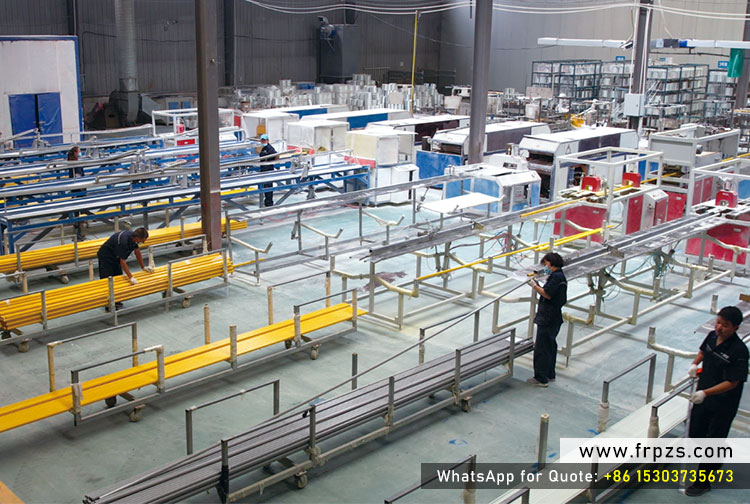
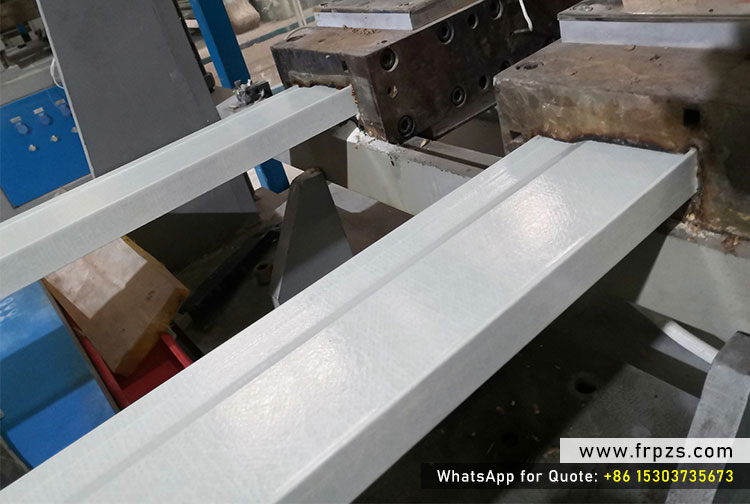
Modern FRP pultrusion manufacturing factory line
How to Choose a Reliable Pultrusion Manufacturer
Quick Answer:
A reliable pultrusion manufacturer should have strong engineering capability, advanced production equipment, in-house pultrusion mold design, strict quality control systems, and proven experience in producing custom FRP profiles for industrial applications.
As demand for pultrusion products continues to grow worldwide, choosing the right supplier has become a critical factor in project success. A qualified manufacturer does not only produce composite profiles but also provides engineering support, material selection guidance, and custom design solutions.
Engineering Insight
The difference between an average supplier and a professional pultrusion manufacturer is not only production capacity, but also the ability to design optimized profiles that reduce cost and improve structural performance.
Key Factors When Selecting a Pultrusion Factory
When evaluating a pultrusion factory or supplier, engineers and procurement teams should consider the following key factors:
- Engineering and design capability
- Custom pultrusion mold development ability
- Production line capacity and automation level
- Material sourcing and traceability
- Quality control system (ISO standards)
- Mechanical testing capability
- Experience in international projects
- OEM and ODM service support
- After-sales technical support
- Delivery reliability and lead time
Why Engineering Capability Matters
A professional pultrusion manufacturer should be able to analyze load conditions, environmental requirements, and installation conditions before designing a composite profile.
This ensures that the final product is not only manufacturable but also optimized for performance and cost efficiency.
Custom Pultrusion Manufacturing Capability
One of the most important indicators of a high-level supplier is the ability to provide custom pultrusion solutions.
This includes:
- Custom profile design based on drawings
- Optimization of structural geometry
- Selection of fiber and resin systems
- Pultrusion die design and manufacturing
- Prototype testing and validation
- Mass production capability
Did You Know?
Many complex industrial structures can be simplified into a single custom pultruded profile, reducing assembly time and improving overall structural integrity.
Importance of Pultrusion Mold Quality
The pultrusion mold (die) is one of the most important components in the entire manufacturing process. High-quality molds ensure consistent dimensions, smooth surface finish, and stable long-term production.
A professional manufacturer should have in-house or closely controlled mold design and machining capabilities.
Quality Control Systems
A reliable pultrusion factory must implement strict quality control procedures at every stage of production.
- Raw material inspection
- Fiber alignment verification
- Resin system testing
- Dimensional inspection
- Mechanical property testing
- Surface quality inspection
- Batch traceability management
Global Market Experience
Experienced pultrusion manufacturers typically serve multiple international markets, including construction, infrastructure, renewable energy, and industrial engineering sectors.
Global experience ensures that products comply with international standards such as ASTM, ISO, EN, and project-specific specifications.
Common Mistakes When Choosing Suppliers
Many buyers make the mistake of selecting suppliers based only on price. However, this often leads to long-term issues such as inconsistent quality, poor dimensional control, and limited engineering support.
Instead, buyers should prioritize:
- Technical capability over price
- Quality consistency over short-term savings
- Engineering support over basic production
- Long-term reliability over one-time cost reduction
Key Takeaways
- Choosing the right pultrusion manufacturer is critical for project success.
- Engineering capability is more important than price alone.
- Custom pultrusion capability reflects the technical strength of a factory.
- High-quality pultrusion molds ensure stable production and product consistency.
- International experience ensures compliance with global engineering standards.
Frequently Asked Questions About Pultrusion Process and Products
Quick Answer:
This FAQ section covers the most commonly asked questions about pultrusion process, pultrusion composites, pultrusion products, and custom pultrusion manufacturing. It helps engineers, buyers, and project managers better understand material selection, production methods, and application scenarios.
General Questions About Pultrusion
1. What is the pultrusion process?
The pultrusion process is a continuous manufacturing method used to produce fiber reinforced composite profiles by pulling fibers through resin and a heated die.
2. How does pultrusion work?
It works by impregnating continuous fibers with resin, shaping them in a heated die, and pulling them into final cured profiles.
3. What are pultrusion composites?
Pultrusion composites are materials made from reinforced fibers and thermosetting resins produced through the pultrusion process.
4. What products can be made by pultrusion?
Common products include square tubes, channels, I beams, rods, flat bars, cable trays, and custom profiles.
5. What is the main advantage of pultrusion?
High strength-to-weight ratio, corrosion resistance, and long service life are the main advantages.
6. Is pultrusion better than extrusion?
Pultrusion is better for high-strength composite structural profiles, while extrusion is mainly used for metals and plastics.
7. What industries use pultruded products?
Construction, electrical, marine, chemical, transportation, and renewable energy industries widely use pultruded composites.
8. What is custom pultrusion?
Custom pultrusion is the process of manufacturing composite profiles according to specific customer design requirements.
9. Can pultrusion replace steel?
Yes, in many corrosion-prone and lightweight structural applications, pultrusion can replace steel.
10. How strong is pultruded fiberglass?
Pultruded fiberglass has high tensile strength, often comparable to steel in specific applications but with much lower weight.
Material and Performance Questions
11. What materials are used in pultrusion?
Glass fiber, carbon fiber, basalt fiber, polyester resin, vinyl ester resin, and epoxy resin are commonly used.
12. Does FRP rust?
No, FRP (Fiber Reinforced Polymer) does not rust or corrode.
13. Is pultruded composite waterproof?
Yes, pultruded composites have very low water absorption and excellent moisture resistance.
14. Can pultrusion withstand UV exposure?
Yes, UV-resistant resins can be used for outdoor applications.
15. Is pultrusion fire resistant?
Fire-retardant resins can be used to improve flame resistance performance.
16. What is the lifespan of pultrusion products?
Typically 30–50 years or more depending on environmental conditions.
17. Are pultrusion products conductive?
No, they are electrically non-conductive.
18. Are pultrusion products magnetic?
No, they are non-magnetic.
19. What is fiber volume fraction?
It is the percentage of fiber content in composite materials, usually between 55%–75%.
20. Why is resin important?
Resin binds fibers, transfers load, and provides environmental protection.
Manufacturing Questions
21. What is a pultrusion machine?
A pultrusion machine is equipment used to continuously produce composite profiles by pulling fibers through a heated die.
22. What is a pultrusion die?
A pultrusion die is a precision steel mold that shapes and cures the composite profile.
23. Can pultrusion make custom shapes?
Yes, custom profiles can be designed and produced using specialized dies.
24. What is the production speed of pultrusion?
Typically between 0.2–2 meters per minute depending on profile complexity.
25. Is pultrusion continuous?
Yes, it is a continuous manufacturing process.
26. Can pultrusion be automated?
Yes, modern pultrusion lines are highly automated.
27. What is pull speed?
Pull speed is the rate at which the profile is drawn through the die.
28. What affects pultrusion quality?
Fiber alignment, resin quality, die temperature, and pull speed.
29. Can pultrusion produce large profiles?
Yes, but size depends on machine and die capability.
30. What is post-processing in pultrusion?
It includes cutting, drilling, and machining after production.
Application Questions
31. Where is pultrusion used?
Used in construction, bridges, solar energy, marine, chemical plants, and utilities.
32. Why use pultrusion in marine environments?
Because it resists saltwater corrosion.
33. Is pultrusion good for bridges?
Yes, due to high strength and corrosion resistance.
34. Can pultrusion be used in solar farms?
Yes, especially for mounting structures.
35. Is pultrusion used in electrical systems?
Yes, because it is non-conductive.
36. Can pultrusion be used outdoors?
Yes, it is weather resistant.
37. Is pultrusion suitable for chemical plants?
Yes, especially vinyl ester resin systems.
38. Can pultrusion replace aluminum?
In many structural applications, yes.
39. Is pultrusion used in transportation?
Yes, in rail, automotive, and infrastructure systems.
40. Can pultrusion be recycled?
Recycling is limited but improving with modern technologies.
Business and Procurement Questions
41. How to choose a pultrusion manufacturer?
Look for engineering capability, quality control, and custom design experience.
42. What is a pultrusion supplier?
A company that produces and supplies pultruded composite profiles.
43. Is China a good source for pultrusion products?
Yes, China has advanced pultrusion manufacturing capability and competitive pricing.
44. What is OEM pultrusion?
OEM means manufacturing products based on customer designs.
45. What is ODM pultrusion?
ODM includes design and manufacturing services.
46. How much does pultrusion cost?
Cost depends on material, profile design, and production volume.
47. Is custom pultrusion expensive?
Initial mold cost is higher, but long-term cost is lower for large projects.
48. What is the lead time for pultrusion products?
Typically depends on mold design and production volume.
49. What certifications are needed?
ISO, ASTM, and project-specific certifications are commonly required.
50. How to contact a pultrusion factory?
Through official websites, email inquiry, or technical consultation requests.
Key Takeaways
- This FAQ covers the most important technical and commercial questions about pultrusion.
- Pultrusion is widely used in engineering due to its durability and corrosion resistance.
- Custom pultrusion allows tailored solutions for complex projects.
- Material selection and manufacturing quality are critical for performance.
- Understanding these FAQs helps buyers make better engineering decisions.
Technical Summary & Engineering Data
Executive Summary:
This article provides a complete guide to the pultrusion process, covering pultrusion composites, pultrusion products, and custom pultrusion solutions.
It explains FRP profiles, fiberglass pultrusion materials, manufacturing methods, industrial applications, and how to choose a reliable pultrusion manufacturer.
The content is designed for engineers, procurement teams, and global buyers in construction, infrastructure, energy, marine, and industrial sectors.
| Pultrusion Article Structured Data |
| Main Topic |
Pultrusion Process & FRP Composite Profiles |
| Core Keywords |
pultrusion process, pultrusion composites, pultrusion products, custom pultrusion, FRP profiles |
| Materials |
Glass fiber, carbon fiber, basalt fiber, polyester resin, vinyl ester resin, epoxy resin |
| Main Products |
FRP square tube, FRP I beam, FRP channel, FRP angle, FRP rod, FRP cable tray, custom profiles |
| Industries |
Construction, bridges, solar energy, wind power, marine, chemical plants, wastewater treatment |
| Manufacturing Type |
Continuous pultrusion process |
| Business Type |
OEM / ODM pultrusion manufacturer |
| Key Advantage |
Lightweight, corrosion resistance, electrical insulation, long service life |
Engineering Q&A
Frequently Asked Technical Questions
Q1: What is the pultrusion process?
A: The pultrusion process is a continuous manufacturing method used to produce FRP composite profiles by pulling fibers through resin and a heated die.
Q2: What are pultrusion composites?
A: Pultrusion composites are materials made from continuous fibers and thermosetting resins produced through the pultrusion process.
Q3: What products are made by pultrusion?
A: FRP square tubes, I beams, channels, rods, flat bars, cable trays, and custom composite profiles.
Q4: Can pultrusion replace steel?
A: Yes, in corrosion environments and lightweight structural applications, pultruded composites can replace steel.
Q5: What is custom pultrusion?
A: Custom pultrusion is the manufacturing of FRP profiles based on customer drawings and engineering requirements.
Q6: What industries use pultrusion products?
A: Construction, bridges, solar energy, wind power, marine engineering, chemical plants, wastewater treatment, and electrical systems.
Q7: What are the advantages of pultrusion?
A: Lightweight, corrosion resistance, long service life, electrical insulation, and low maintenance.
Q8: How to choose a pultrusion manufacturer?
A: Choose a manufacturer with engineering capability, mold design ability, quality control, and OEM/ODM experience.
 +86 15303735673
 Jessica@frpzs.com
 Technical Data