+86 15303735673
 Jessica@frpzs.com
 Technical Data


The Invisible Backbone: How Resin Defines Composite Integrity
In the engineering of Fiber-reinforced plastic (FRP) profiles, the fibers provide the strength, but the resin matrix dictates the life expectancy. As the primary binder, the resin selection determines how the profile interacts with its environment—shielding fibers from UV rays, preventing chemical corrosion, and distributing mechanical loads. At Henan Zhongsheng (FRPZS), we analyze the molecular compatibility of resins to ensure every customized profile thrives in its specific application.
1. The Hierarchy of Resin Systems
Selecting the right polymer matrix is a balance of performance requirements and project economics. Below is a technical breakdown of the three most prevalent systems used in pultrusion and custom molding:
| Resin Type | Corrosion Resistance | Mechanical Adhesion | Heat Distortion (HDT) | Best Use Case |
|---|---|---|---|---|
| Orthophthalic Polyester | Moderate | Standard | 60°C - 80°C | Commercial construction / General profiles |
| Isophthalic Polyester | Good | High | 80°C - 100°C | Marine environments / Cooling towers |
| Vinyl Ester | Excellent | Superior | 100°C - 120°C | Chemical plants / Wastewater treatment |
| Epoxy | Superior | Maximum | 120°C - 180°C+ | Aerospace / High-load structural parts |
2. Polyester Resins: The Foundation of Versatility
Polyester resins remain the workhorse of the FRP industry. They are valued for their fast curing cycles and cost-efficiency. For non-corrosive structural beams or decorative cladding, polyester offers a reliable ROI without over-engineering the solution.
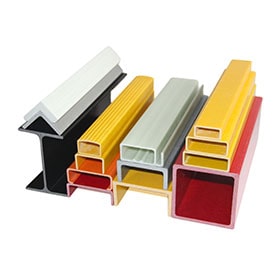
Standard structural I-beam utilizing high-grade Isophthalic Polyester.
3. Vinyl Ester: The Corrosion Champion
Vinyl Ester resins are a hybrid, combining the toughness of epoxy with the processability of polyester. By having fewer ester groups in the molecular chain, they are significantly less susceptible to hydrolysis (water damage) and acid attack. This makes them the definitive choice for fiberglass sheet piles and chemical-resistant walkways.

High-durability sheet piles engineered with Vinyl Ester for saline soil conditions.
Expert Technical FAQ: Resin Performance & Selection
Q1: "Can I use UV-stabilized polyester for outdoor profiles instead of Vinyl Ester?"
A: Yes, for general sunlight exposure, UV additives in polyester are sufficient. However, if the environment is both sunny and highly acidic or saline, Vinyl Ester is required for long-term structural integrity.
Q2: "Why is Epoxy rarely used in standard pultrusion profiles?"
A: Epoxy resins have higher viscosity and slower curing times, making the pultrusion process more complex and expensive. It is typically reserved for specialized carbon fiber or high-voltage applications.
Q3: "What is HDT and why does it matter for resin choice?"
A: Heat Distortion Temperature (HDT) is the point where the resin begins to soften. Selecting a resin with an HDT 20°C higher than your peak operating temperature is crucial to prevent profile sagging.
Q4: "Does resin selection affect the 'Fiber Bloom' phenomenon?"
A: Absolutely. Higher-quality resins with better fiber-wetting properties (like Vinyl Ester) create a more robust surface layer, significantly delaying fiber-blooming compared to low-grade ortho-polyesters.
Q5: "Are there eco-friendly resin options for FRP?"
A: Bio-based resins derived from vegetable oils or recycled PET are increasingly available. They offer a lower carbon footprint while maintaining 85-90% of the mechanical strength of traditional resins.
Q6: "How do pigments interact with different resin types?"
A: Polyester and Vinyl Ester accept pigments very well for integral coloring. Epoxy can be more sensitive, sometimes requiring specialized UV-stable pigment pastes to prevent yellowing.
Q7: "Can I mix resin types in a single profile?"
A: Generally, no. Resins have different shrinkage rates and chemical bonding properties. Mixing them can lead to delamination and internal stress within the customized profile.
Q8: "What is the role of 'Fillers' in resin selection?"
A: Fillers like calcium carbonate or alumina trihydrate are added to modify viscosity, reduce cost, or add fire retardancy (FR). The base resin must be compatible with these additives to maintain strength.
Tailor Your Composite Solution with FRPZS
At Henan Zhongsheng Composite Materials Co., Ltd., we don't just sell profiles; we engineer material systems. Our technical lead, Jessica Huang, can guide you through the complexities of resin chemistry to ensure your customized FRP profiles outperform every expectation.
Get a professional material assessment for your project:
- Technical Consultant: Jessica Huang
- Email: Jessica@frpzs.com
- Direct Line (WhatsApp): +86 15303735673