+86 15303735673
 Jessica@frpzs.com
 Technical Data


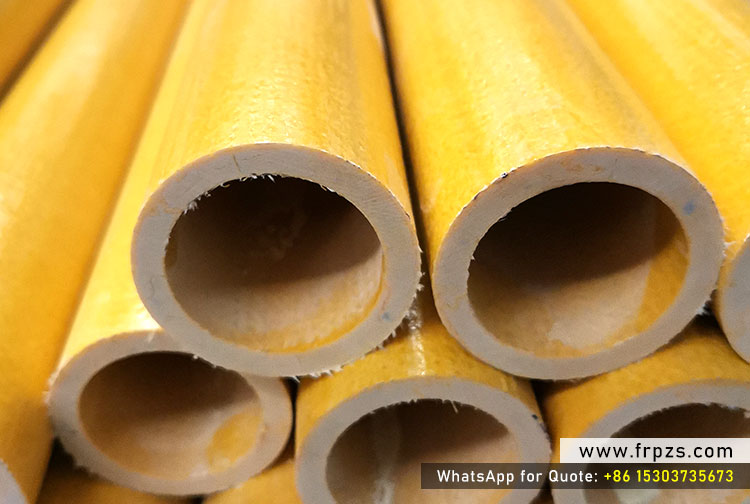
FRP round tubes offer exceptional corrosion resistance, high strength-to-weight ratio, and dimensional stability for industrial applications
FRP Round Tube: Complete Technical Guide for Engineers and Project Managers
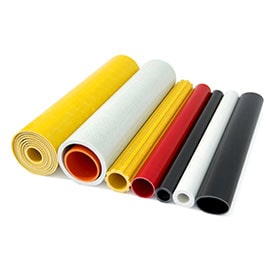
Fiberglass reinforced plastic (FRP) round tubes are among the most versatile and widely used pultruded profiles in industrial applications. From structural supports in corrosive environments to electrical insulation in high-voltage equipment, FRP round tubes deliver exceptional performance where metals fail. This comprehensive guide covers mechanical properties, chemical resistance, standard specifications, and application scenarios to help you make informed specification decisions.
At Henan Zhongsheng Composite Material Co., Ltd, we have manufactured FRP round tubes for 15+ years, supplying projects in 30+ countries across marine, chemical processing, infrastructure, and energy sectors.
1. What Is an FRP Round Tube?
An FRP round tube is a pultruded composite profile with a continuous fiberglass reinforcement (rovings and mats) bonded together by a polymer resin matrix (polyester, vinyl ester, or epoxy). The result is a hollow cylindrical section with:
- Outer surface: Smooth, gelcoat-finished (typically 0.3-0.5mm thick)
- Wall structure: Multi-layer fiberglass reinforcement for optimal strength
- Inner surface: Either smooth (similar to outer) or with internal spiral reinforcement
Key Advantages Over Steel and Aluminum
| Property | FRP Round Tube | Steel (Galvanized) | Aluminum | Advantage |
|---|---|---|---|---|
| Tensile Strength | 250-450 MPa | 370-550 MPa | 90-190 MPa | FRP/Steel comparable |
| Specific Strength (Strength/Weight) | 150-250 kN·m/kg | 50-70 kN·m/kg | 70-90 kN·m/kg | FRP 2-3x higher |
| Weight | 1.8-2.2 g/cm³ | 7.85 g/cm³ | 2.7 g/cm³ | FRP 75-80% lighter |
| Corrosion Resistance | Excellent (inherent) | Poor (requires coating) | Moderate (pitting) | FRP superior |
| Electrical Insulation | Excellent (non-conductive) | Conductive | Conductive | FRP unique |
| Thermal Conductivity | Low (0.3-0.4 W/m·K) | High (45 W/m·K) | High (180 W/m·K) | FRP (insulation) |
| Service Life (corrosive env.) | 50+ years | 5-15 years | 10-20 years | FRP 3-5x longer |
2. Standard Sizes and Specifications
FRP round tubes are manufactured in a wide range of standard sizes. Below are the most common specifications:
Standard Outside Diameter (OD) Range
| OD (mm) | Wall Thickness (mm) | ID (mm) | Weight (kg/m) | Typical Applications |
|---|---|---|---|---|
| 12 | 2.0-3.0 | 8-6 | 0.15-0.25 | Antenna masts, hobby, small structural |
| 19 | 2.5-4.0 | 14-11 | 0.30-0.50 | Flag poles, handrails, tool handles |
| 25 | 3.0-5.0 | 19-15 | 0.50-0.85 | Construction formwork, electrical conduit |
| 32 | 3.5-5.0 | 25-22 | 0.80-1.15 | Light structural, marine rigging |
| 38 | 4.0-6.0 | 30-26 | 1.10-1.60 | Handrails, structural posts |
| 50 | 5.0-8.0 | 40-34 | 1.80-2.80 | Structural columns, platform supports |
| 60 | 5.0-10.0 | 50-40 | 2.30-4.20 | Heavy structural, industrial applications |
| 76 | 6.0-10.0 | 64-56 | 3.50-5.50 | Chemical storage, large structural |
| 100 | 8.0-12.0 | 84-76 | 6.00-8.80 | Piling, large diameter structural |
| 150 | 10.0-15.0 | 130-120 | 11.5-17.0 | Marine pilings, large infrastructure |
Standard Lengths
- Stock lengths: 3.0m, 3.66m, 4.0m, 6.0m
- Custom lengths: Available up to 12m (depending on OD and shipping constraints)
- Cut-to-length: Available with precision cutting (±1mm tolerance)
3. Mechanical Properties
Mechanical properties vary based on reinforcement type, resin system, and fiber content. Typical values for standard polyester resin pultruded round tubes:
| Property | Test Method | Typical Value | Notes |
|---|---|---|---|
| Tensile Strength | ASTM D638 | 250-450 MPa | Longitudinal direction |
| Tensile Modulus | ASTM D638 | 17-25 GPa | Longitudinal |
| Flexural Strength | ASTM D790 | 200-350 MPa | |
| Flexural Modulus | ASTM D790 | 10-17 GPa | |
| Compressive Strength | ASTM D695 | 150-250 MPa | |
| Shear Strength | ASTM D2344 | 20-30 MPa | Interlaminar |
| Elongation at Break | ASTM D638 | 1.5-3.0% | Typical FRP brittle behavior |
| Density | ASTM D792 | 1.8-2.2 g/cm³ | |
| Water Absorption | ASTM D570 | < 0.5% | 24h immersion |
4. Resin System Selection
Choosing the correct resin system is critical for long-term performance in your specific environment:
| Resin Type | Chemical Resistance | Temperature | UV Resistance | Cost | Best Applications |
|---|---|---|---|---|---|
| Polyester (ISO) | Good - mild acids/alkalis | -20 to +65°C | Moderate (needs coating) | Lowest | General industrial, water treatment |
| Vinyl Ester | Excellent - acids, alkalis, solvents | -20 to +80°C | Good | Medium | Chemical processing, pulp & paper |
| Epoxy | Excellent - solvents, oils | -30 to +100°C | Good | High | High-temp, aerospace, marine |
| Phenolic | Very Good - acids, fire | -30 to +150°C | Excellent | High | Fire-rated, smoke-toxicity critical |
Recommendation
For most outdoor and general industrial applications, standard polyester resin with UV-resistant gelcoat provides excellent value. For chemical plant environments or marine applications, vinyl ester resin is strongly recommended for its superior corrosion resistance.
5. Common Applications by Industry
5.1 Marine Industry
- Boat masts and spars: Lightweight, non-corroding replacement for aluminum
- Railings and stanchions: Low maintenance, no painting required
- Docking pilings: Resistant to marine borers and saltwater
- Fish farm cages: Non-corrosive in saltwater environments
5.2 Chemical Processing
- Process pipe supports: Acid/alkali resistant structural members
- Platform columns: Non-corroding in harsh chemical environments
- Cooling tower structures: Resists chlorine and moisture
- Battery rack components: Acid-resistant, non-sparking
5.3 Electrical Utilities
- Transformer bus supports: Excellent dielectric properties
- Insulator cores: High electrical insulation, light weight
- High-voltage equipment mounting: Non-conductive, maintenance-free
- Cable management supports: No grounding required
5.4 Construction and Architecture
- Architectural columns: Aesthetic, lightweight, weather-resistant
- Canopy supports: Corrosion-resistant for outdoor structures
- Formwork studs: Lightweight, reusable
- Rooftop equipment supports: Corrosion-resistant, easy installation
5.5 Transportation
- Railway third rail supports: Electrical insulation, durability
- Highway signposts: Lightweight, impact-resistant, no corrosion
- Airport lighting supports: Non-corroding, maintenance-free
- Vehicle roll cages: High strength-to-weight ratio
6. Design Considerations and Calculations
6.1 Load Capacity Calculation
FRP round tubes are typically used as compression members (columns) or bending members (beams). Basic design considerations:
Column Buckling (Compression)
Critical buckling load (Euler formula):
Pcr = π²EI / (KL)²
- Pcr: Critical buckling load (N)
- E: Modulus of elasticity (Pa) — typically 17 GPa for FRP
- I: Moment of inertia (m⁴) — I = π(OD⁴ - ID⁴)/64
- K: Effective length factor (0.7 for fixed-fixed, 1.0 for pinned-pinned)
- L: Unsupported length (m)
Bending (Flexure)
Maximum bending stress:
σ = M y / I = M / S
- M: Maximum bending moment (N·m)
- y: Distance from neutral axis to outer fiber (m)
- S: Section modulus (m³) — S = π(OD⁴ - ID⁴)/(32×OD)
Design Note
Always apply a safety factor of 3-4 for permanent structural applications. For dynamic loads or impact, increase to 5-6. Consult with a structural engineer familiar with FRP materials for critical applications.
6.2 Deflection Limits
Recommended deflection limits for FRP round tube applications:
- Structural members (live load): L/200 to L/250
- Structural members (dead load): L/400 to L/500
- Aesthetic/architectural: L/180 to L/200
- Crane/hoist supports: L/400 to L/600
7. Connection Methods
FRP round tubes can be connected using various methods, each with specific advantages:
| Connection Type | Advantages | Disadvantages | Applications |
|---|---|---|---|
| Bolted (through) | Removable, simple, strong | Stress concentration | Structural frames, supports |
| Adhesive bonding | Smooth appearance, no stress concentration | Surface prep critical, permanent | Architectural, aesthetic |
| Socket/Fitting | Modular, adjustable | Special fittings required | Railing systems, frames |
| Welding (thermo) | Strong joint, seamless | Special equipment, skill | Large structural assemblies |
| Fiberglass wrapping | Very strong, corrosion-free | Labor-intensive, skill required | High-load connections |
Important Note on Fasteners
Always use stainless steel (316L recommended) or titanium fasteners when connecting FRP tubes. Galvanized fasteners will corrode in contact with FRP in moist environments. Avoid using dissimilar metals without proper isolation.
8. Installation Best Practices
- Handling: Use soft slings; avoid chains or wire ropes that can damage the gelcoat.
- Cutting: Use carbide-tipped blades or diamond saws; avoid high-speed grinding which melts resin.
- Drilling: Use twist drills designed for composites; peck drilling to avoid overheating.
- Support spacing: Do not exceed manufacturer-recommended span for your load requirements.
- Alignment: Ensure proper alignment before final fastening; FRP has less forgiveness than metal.
- Expansion joints: Account for thermal expansion (approximately 10-15 x 10⁻⁶ /°C).
9. Quality Certifications and Testing
When sourcing FRP round tubes, ensure the manufacturer provides:
- Material certificates: Resin type, fiber content, reinforcement specifications
- Mechanical test reports: Tensile, flexural, and compressive properties
- Dimensional inspection: OD, ID, wall thickness tolerances
- Surface quality: Gelcoat thickness, absence of voids, proper cure
- Industry certifications: ISO 9001, ASTM compliance
“FRP round tubes represent a strategic material choice when the total cost of ownership—including maintenance, downtime, and replacement—is considered. While initial cost may be 20-40% higher than steel, the 30-50 year maintenance-free service life typically delivers 3-5x lower lifecycle costs in corrosive environments.”
Need Custom FRP Round Tubes?
Henan Zhongsheng manufactures FRP round tubes in standard and custom sizes, with polyester, vinyl ester, or epoxy resin systems. We offer:
- OD from 12mm to 150mm+
- Custom wall thicknesses
- Various surface finishes (smooth, grit, corrugated)
- Cut-to-length and custom drilling services
- Technical support for design calculations
Browse Our Products: FRP Round Tube | FRP Square Tube | All FRP Profiles
Related Equipment: Pultrusion Machine | Pultrusion Dies
Frequently Asked Questions (FAQ)
Q: What is the maximum length of FRP round tubes you can manufacture?
A: Standard maximum length is 12m. For standard sizes (50mm OD and below), we can produce up to 6m in 20ft container and 12m in 40ft HC container. For larger diameters, length may be limited by shipping constraints.
Q: Can FRP round tubes be used as structural columns?
A: Yes, FRP round tubes are excellent compression members. Design should follow appropriate codes (e.g., ASCE/SEI 48-05 for pultruded FRP structural members). Apply appropriate safety factors (3-4 minimum for permanent loads).
Q: How do I calculate the right wall thickness for my application?
A: This depends on your load, span, and deflection requirements. Provide your specifications to our engineering team and we will perform the calculations. As a rough guide: for light structural (handrails), 3-4mm wall; for medium structural (platforms), 5-6mm; for heavy structural (columns), 8mm+.
Q: What is the fire resistance of FRP round tubes?
A: Standard polyester FRP has limited fire resistance. For fire-rated applications, specify phenolic resin (fire-retardant, low smoke) or add fire-retardant additives. FRP will char and self-extinguish with certain formulations.
Q: Can FRP round tubes be painted or coated?
A: Yes, but surface preparation is critical. Light sanding (80-120 grit), proper cleaning, and compatible primers are required. However, one advantage of FRP is that it typically does not require painting—the gelcoat provides long-lasting color and UV protection.