+86 15303735673
 Jessica@frpzs.com
 Technical Data


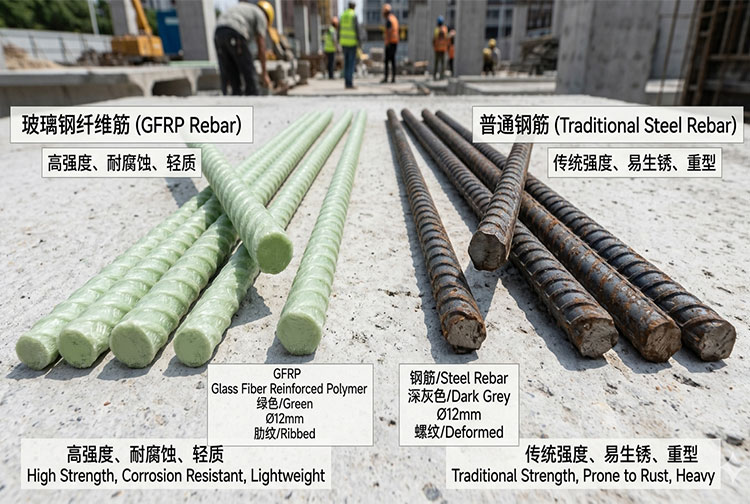
FRP Rebar vs Steel Rebar
The Smart Investment: A Comprehensive Cost-Benefit Analysis of FRP Rebar vs. Traditional Steel
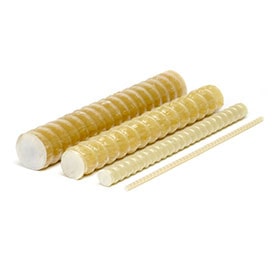
Corrosion of steel reinforcement is a silent crisis, costing the global construction industry over $2.5 trillion annually. In harsh environments—coastal regions, chemical processing plants, and infrastructure exposed to de-icing salts—traditional steel rebar often begins to fail within just 10-15 years. This leads to a cycle of expensive repairs and structural risks. Fiber Reinforced Polymer (FRP) rebar has emerged as a definitive, corrosion-proof alternative, but the question for many engineers remains: Is the investment justified?
1. Material Properties: Beyond Basic Reinforcement
Understanding the mechanical differences is the first step in a successful transition from steel to composites. While steel is isotropic, FRP rebar offers unique directional strength and electromagnetic properties.
| Property | Steel Rebar (Grade 60) | GFRP Rebar (FRPZS Standard) | Advantage |
|---|---|---|---|
| Tensile Strength | 400 - 600 MPa | 600 - 1,200 MPa | FRP +50-100% |
| Density (Weight) | 7.85 g/cm³ | 1.9 - 2.2 g/cm³ | FRP 75% Lighter |
| Conductivity | Highly Conductive | Non-Conductive | Safety & MRI Friendly |
2. Installation Economics: The "Hidden" Savings
While the initial purchase price of FRP rebar may be higher per meter, its lightweight nature delivers significant logistical and labor dividends:
- Logistical Efficiency: A single truckload can carry 35+ tons of FRP equivalent, a 40% increase in capacity over heavy steel.
- Labor Reduction: Because it is 75% lighter, workers can handle the material manually with far less reliance on heavy cranes, leading to a 30-50% reduction in labor hours.
- On-Site Processing: Cutting and drilling can be performed with standard carbide tools, accelerating the construction timeline by 20-30%.
3. The 50-Year Lifecycle Horizon
For critical infrastructure like bridge decks (approx. 1,000 m²), the "Total Cost of Ownership" tells the real story. When maintenance, major repairs, and eventual replacement costs are factored in, FRP rebar typically delivers a 50% net saving over a 50-year span.
Case Study Snapshot: Haynes Inlet Bridge
By utilizing GFRP rebar in the bridge deck and barriers, engineers achieved a 100+ year design life and avoided an estimated $2.3 million in maintenance costs over 50 years.
4. Application-Specific Selection
At Henan Zhongsheng Composite Material Co., Ltd, we recommend FRP rebar as the "Clear Choice" for:
- Marine & Coastal: Seawalls, docks, and offshore platforms.
- Specialized Medical: MRI facilities requiring non-magnetic reinforcement.
- Chemical Plants: Wastewater tanks and chemical storage areas.
- Power Infrastructure: High-voltage substations requiring electrical insulation.
"Choosing FRP rebar isn't just a material swap; it's a strategic investment in the resilience and longevity of our global infrastructure."
Engineering Guidelines & Compliance
Transitioning to FRP requires attention to specific design codes. Our equipment and products are manufactured to meet or exceed major international standards, including ACI 440.1R (USA), CSA S806 (Canada), and GB/T 26743 (China). When designing with FRP, remember that serviceability (deflection and crack width) often governs the design over ultimate strength.
Get a Tailored Cost-Benefit Analysis
Are you bidding on an infrastructure project? Our engineering team at Henan Zhongsheng provides free technical consultations and custom design calculations to help you specify the right reinforcement solution.
Explore Our Tech: www.frpzs.com
Frequently Asked Questions (FAQ)
Q: Can FRP rebar be bent on-site?
A: No. FRP rebar must be factory-bent. Field bending can cause fiber damage. Our production lines can be customized to produce any required geometry.
Q: Is it fire-resistant?
A: Standard FRP loses strength above 200°C. For extreme fire requirements, we recommend intumescent coatings or CFRP (Carbon) alternatives.