+86 15303735673
 Jessica@frpzs.com
 Technical Data


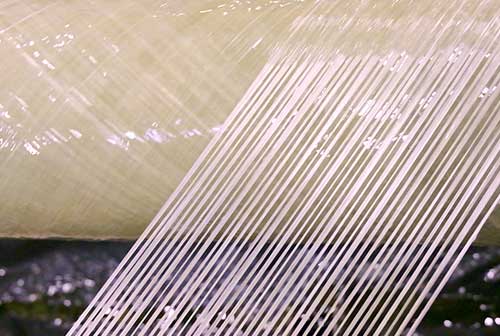
Technical Overview: In the realm of FRP (Fiber Reinforced Polymer) manufacturing, Filament Winding and Pultrusion represent the gold standards for high-strength applications. While both utilize continuous reinforcement, they diverge in their Fiber Architecture. Filament winding excels in multi-axial stress distribution (ideal for vessels), while pultrusion offers unmatched longitudinal integrity and high-volume cost efficiency. Henan Zhongsheng provides an analytical guide to these two critical manufacturing paths.
1. Filament Winding: Precision in Multiaxial Stress
The Filament Winding process involves winding continuous rovings onto a rotating mandrel at controlled angles. This allows engineers to "program" the strength of the part based on the expected load.
- Helical and Hoop Winding: By varying the winding angle, we can optimize the part for internal pressure (Hoop stress) or axial tension. This makes it the premier choice for Pressure Vessels and storage tanks.
- High Fiber Content: The tension applied during winding results in high fiber compaction, leading to exceptional stiffness and strength-to-weight ratios.
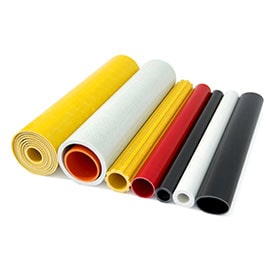
- Applications: High-pressure oxygen tanks, aerospace fuselage sections, chemical pipes, and heavy-duty drivetrain shafts.
2. Pultrusion: The Industrial Powerhouse for Profiles
Pultrusion is a continuous molding process where fibers are saturated in a resin bath and pulled through a heated stationary die. As the material exits the die, it is a fully cured, solid profile.
- Uninterrupted Production: Unlike batch-based filament winding, pultrusion is a 24/7 continuous process, making it the most Cost-Effective method for large-scale infrastructure projects.
- Longitudinal Dominance: Because the fibers are pulled straight, pultruded profiles exhibit incredible Axial Tensile Strength, outperforming filament winding in linear applications like beams and rods.
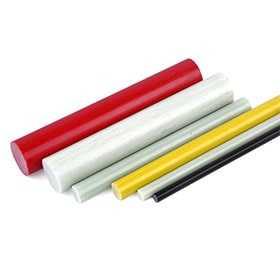
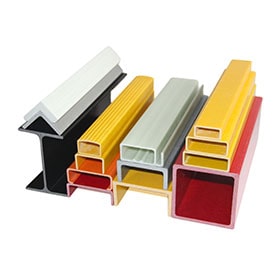
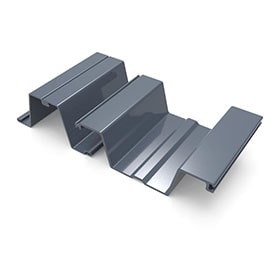
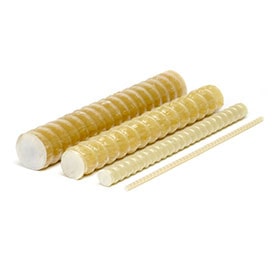
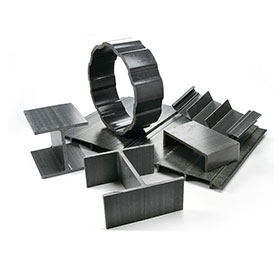
- Applications: Structural I-beams, FRP Rebar, tool handles, bridge decks, and cable trays.
Engineering Comparison: Pultrusion vs. Filament Winding
| Property Metric | Filament Winding | Pultrusion |
|---|---|---|
| Primary Fiber Orientation | Adjustable (Helical/Hoop/Polar) | Unidirectional (Longitudinal) |
| Production Nature | Batch / Discontinuous | Continuous / Highly Automated |
| Part Complexity | Cylindrical, Spherical, Tapered | Constant Cross-Section Profiles |
| Structural Strength | Superior in Torsional/Pressure Loads | Superior in Axial Tension/Flexure |
| Economies of Scale | Better for Custom/Complex Units | Best for High-Volume Infrastructure |
3. Strategic Selection: Which Method to Choose?
The choice between these two methods hinges on the Stress State of the final component:
- Choose Filament Winding if: You are designing a part that must contain internal pressure (like a tank) or handle complex torsion. The ability to wind fibers at 45° or 90° angles is crucial for these scenarios.
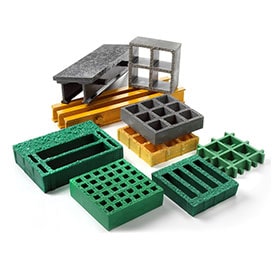
- Choose Pultrusion if: You need miles of consistent material with high stiffness in one direction. For beams, handles, and gratings, pultrusion provides the highest ROI (Return on Investment) due to its speed and minimal labor requirements.
Technical FAQ: Filament Winding vs. Pultrusion
Q1: Is pultrusion really weaker than filament winding?
A: Not exactly. In Axial Tensile Strength, pultrusion is often stronger because fibers are perfectly aligned. Filament winding is "stronger" only in the sense that it can handle loads from multiple directions (like internal pressure) better than a unidirectional pultruded part.
Q2: Can pultrusion produce curved parts?
A: Standard pultrusion is for straight profiles. While "curved pultrusion" exists, it is highly specialized and expensive. For curved or tapered pipes, Filament Winding is the far superior and more flexible choice.
Q3: Which process has better surface finish?
A: Pultrusion typically offers a smoother, "mirror-like" finish because the resin is cured against a polished steel die. Filament wound parts often have a slight "ribbed" texture from the fiber tows unless secondary grinding is performed.
Q4: Why is filament winding considered more expensive?
A: It is a slower, batch-oriented process that often requires a removable mandrel. The cycle time per part is higher, and the equipment setup for complex patterns requires more highly skilled technicians.
Q5: Which method is more common in renewable energy?
A: Both are vital. Pultrusion is used for wind turbine blade spars and solar panel supports, while filament winding is the industry standard for hydrogen storage tanks and high-pressure fuel lines.
Q6: How does Henan Zhongsheng ensure quality in pultrusion?
A: We utilize multi-zone precision temperature control in our dies and automated tensioning systems for the fiber rovings, ensuring every meter of our FRP profiles meets international ASTM standards.
Your Global Partner for Pultruded FRP Solutions
At Henan Zhongsheng Composite Materials Co., Ltd., we specialize in the Pultrusion Process, delivering high-volume, high-precision fiberglass profiles to the world’s most demanding industries. From construction rebar to custom industrial beams, our 20+ years of experience ensure that your project benefits from the best in composite technology.
Contact Jessica Huang for Technical Data & Custom Quotes:
- Email: Jessica@frpzs.com
- WhatsApp: +86 15303735673
- Certified Excellence: Supplying premium pultruded composites to India, USA, Europe, and Australia.