+86 15303735673
 Jessica@frpzs.com
 Technical Data


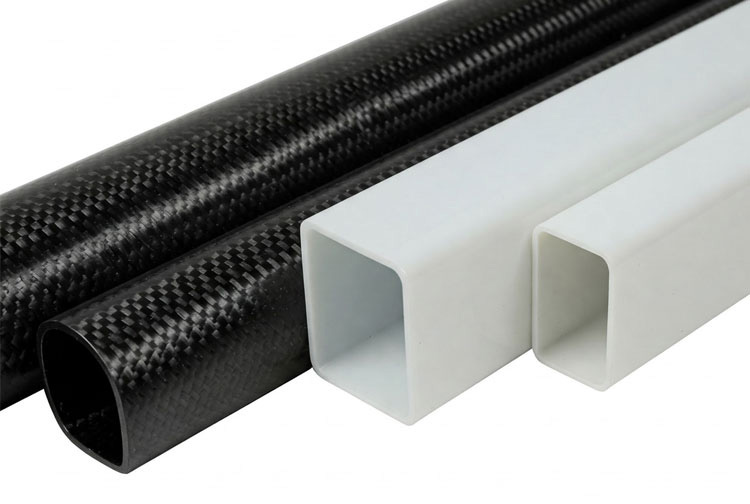
Engineering Brief: The divergence between Carbon Fiber (CFRP) and Glass Fiber (GFRP) lies in their atomic bonding and crystalline orientation. While CFRP offers a peak Specific Strength for weight-critical aerospace applications, GFRP remains the industry workhorse for Dielectric Integrity and cost-effective corrosion resistance. As a high-tier FRP pultrusion profile manufacturer, Henan Zhongsheng provides the technical data necessary to bridge the gap between material science and structural execution.
1. Microstructural Analysis: The Carbon vs. Glass Advantage
Understanding the fundamental differences requires looking at the fiber-matrix interface. CFRP utilizes carbon atoms bonded in a hexagonal pattern (graphene layers), providing an incredibly high modulus along the fiber axis. This results in profiles that exhibit near-zero creep under sustained loads. In contrast, GFRP uses silica-based glass filaments, which are amorphous and isotropic, offering superior flexibility and impact energy absorption.
In the pultrusion process, we optimize the Interfacial Shear Strength (IFSS) by selecting resin systems (Epoxy vs. Vinylester) that chemically bond with the specific fiber sizing, ensuring that the composite acts as a monolithic unit under extreme flexural stress.
Comparative Mechanical Properties (Standard Reference)
| Property | Standard | CFRP (High Modulus) | GFRP (E-Glass) |
|---|---|---|---|
| Tensile Modulus | ASTM D3039 | 150 - 230 GPa | 35 - 50 GPa |
| Ultimate Tensile Strength | ASTM D3039 | 2500+ MPa | 1200 - 1800 MPa |
| Coefficient of Thermal Expansion (CTE) | ASTM E228 | -0.1 to 0.1 (ppm/°C) | 5.0 to 8.0 (ppm/°C) |
| Specific Gravity | ASTM D792 | 1.55 - 1.60 | 1.80 - 2.10 |
| Electrical Resistivity | ASTM D257 | 10⁻³ Ω·cm (Conductive) | 10¹⁴ Ω·cm (Insulative) |
2. Strategic Selection: Cost-Performance & Lifecycle
Engineering is the art of balancing performance with budget. The Carbon Fiber Reinforced Polymer advantage is most apparent when mass reduction directly translates to operational savings—such as reducing fuel consumption in aerospace or increasing the cycle speed of robotic arms.
However, Glass Fiber Reinforced Polymer excels in infrastructure. Its Total Cost of Ownership (TCO) is significantly lower for large-scale pultruded frameworks like bridge decks, cooling tower components, and industrial channels. GFRP’s natural resistance to cathodic delamination makes it the superior choice for concrete reinforcement in coastal zones.
Featured Snippets: Advanced Composite FAQ
Q1: Why is CFRP preferred over GFRP for high-frequency vibration damping?
A: CFRP has a much higher Specific Stiffness, which shifts the natural frequency of a structure out of the vibration range. Its high damping ratio allows it to dissipate mechanical energy faster than metals or glass composites, reducing noise and fatigue.
Q2: How does UV radiation affect the service life of CFRP vs GFRP?
A: The fibers (carbon and glass) are largely UV-inert. However, the polymer matrix can suffer from "photo-oxidation." For 25+ year outdoor life, we utilize a polyester surface veil and UV-stabilized resins to prevent surface micro-cracking and fiber exposure.
Q3: Can CFRP and GFRP profiles be recycled?
A: While thermoset composites are challenging to melt, advanced Pyrolysis and Solvolysis techniques now allow for the recovery of carbon fibers from CFRP with minimal strength loss. GFRP is often mechanically ground for use as a high-strength filler in construction materials.
Q4: Is it safe to use CFRP in contact with aluminum or steel?
A: Caution is required. Because CFRP is electrically conductive, it can trigger galvanic corrosion when in direct contact with aluminum in moist environments. An insulating layer of GFRP or a specialized adhesive film is often used as a barrier.
Q5: What is the impact of temperature on the Flexural Strength of these composites?
A: Performance depends on the Glass Transition Temperature (Tg) of the resin. Generally, CFRP maintains its rigidity better at elevated temperatures, but both materials require specialized High-Tg Epoxy or Cyanate Ester resins for environments exceeding 150°C.
Q6: Which material has better "Fatigue Resistance" for long-term loading?
A: CFRP is the winner for fatigue. Carbon fibers can withstand millions of load cycles at high stress levels without significant degradation, whereas glass fibers may experience slow "Static Fatigue" if permanently submerged in high-alkalinity environments without proper resin shielding.
Consult a Global Leader in Pultrusion Manufacturing
Henan Zhongsheng leverages two decades of manufacturing precision to deliver world-class CFRP and GFRP pultruded profiles. From custom aerospace-grade tubes to heavy-duty industrial C-channels, we provide the engineering support to ensure your material choice is the right one.
Contact Jessica Huang for Technical Specs & Factory Pricing:
- Email: Jessica@frpzs.com
- WhatsApp: +86 15303735673
- Solutions: Material selection, custom mold design, and global logistics for India, Australia, and the EU.