+86 15303735673
 Jessica@frpzs.com
 Technical Data


Introduction: The Material Paradigm Shift of 2026
As we navigate 2026, the global infrastructure landscape is moving beyond the "Age of Steel" into the "Age of Composites." Fiber Reinforced Polymer (FRP) has transcended its niche status to become a core structural material. However, for an engineer or procurement professional, understanding the fiber reinforced polymer advantages and disadvantages is not just about choosing a product—it is about mastering a new design philosophy. At Henan Zhongsheng (FRPZS), we advocate for a balanced perspective: leveraging FRP's immunity to corrosion while engineering for its unique elastic properties.
Strategic Advantages: The Case for Total Lifecycle Value
The transition to fiber reinforced polymer is driven by more than just rust resistance; it is about redefining structural ROI.
1. High Specific Strength & Modulus
FRP profiles offer a "strength-to-weight" ratio that is effectively 4 to 5 times higher than structural steel. This allows for thinner sections in pedestrian bridges and offshore platforms, reducing the total "dead load" of the structure and significantly lowering foundation costs.
2. Absolute Corrosion Immunity
Unlike steel which requires sacrificial coatings or galvanization, FRP is molecularly inert. In coastal wastewater plants or chemical refineries, FRP eliminates the $100,000+ annual maintenance costs associated with repainting and structural reinforcement of oxidized metals.
3. Dielectric & RF Transparency
With the expansion of 5G/6G networks and high-voltage DC transmission, FRP’s non-conductive nature is critical. FRP pultrusion profile manufacturers now provide the primary support structures for antenna arrays and transformer substations where metallic interference or electrical arcing is a safety hazard.
Technical Benchmarking: Zhongsheng FRP vs. Structural Steel
| Engineering Property | Zhongsheng Pultruded FRP | Structural Steel (A36) | Standard Reference |
|---|---|---|---|
| Tensile Strength (Longitudinal) | 450 - 3,000 MPa | ~400 MPa | ASTM D638 / ISO 527 |
| Flexural Modulus | 20 - 40 GPa | 200 GPa | Governs Deflection Limits |
| Density (Specific Gravity) | 1.6 - 2.0 g/cm³ | 7.85 g/cm³ | 75% Weight Reduction |
| Thermal Conductivity | 0.3 - 0.5 W/m·K | 50 W/m·K | Superior Thermal Break |
| Maintenance Cycle | 15-20 Year Checks | 3-5 Year Coatings | Lower OPEX (TCO) |
Critical Considerations: Addressing the Disadvantages
A transparent FRP pultrusion profile manufacturer must address the mechanical trade-offs of composites to ensure engineering safety.
- Anisotropy (Directional Strength): FRP is strong along the fibers but weaker perpendicularly. Design Tip: Use 0°/90° cross-ply laminates for components subject to multi-axial stress.
- Deflection-Driven Design: Because the flexural modulus of FRP is lower than steel, structures are usually designed based on Serviceability Limit States (Deflection) rather than Ultimate Limit States (Breaking).
- Linear Elastic Failure: Unlike steel, which yields (bends) before breaking, FRP is linearly elastic until sudden failure. Engineering Solution: We use higher Safety Factors (typically 3.0 to 5.0) to compensate for this lack of ductility.
- Initial CAPEX: The upfront cost per ton of FRP is higher than carbon steel. However, when factoring in the Total Cost of Ownership (TCO) over 50 years, FRP is typically 30-50% cheaper.
10 Technical FAQs for 2026 Structural Projects
Q1: "Can FRP handle 2026-tier fire safety codes for commercial buildings?"
A: Yes. By specifying Phenolic or Brominated resin systems, Zhongsheng profiles achieve Class A flame spread (<25) and extremely low smoke toxicity (ASTM E84).
Q2: "Does FRP 'creep' under heavy long-term loads?"
A: Creep is a factor, but manageable. Engineers should apply a Creep Reduction Factor (typically 0.3 - 0.5) to the design strength for permanent dead loads.
Q3: "How does UV radiation affect these profiles in desert solar farms?"
A: We use integral UV inhibitors and a polyester surface veil to prevent "fiber blooming." For extreme UV zones, an additional polyurethane coating is recommended.
Q4: "Is FRP rebar better than epoxy-coated steel for bridges?"
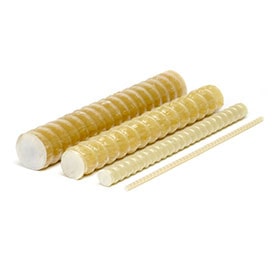
A: In chloride-heavy environments, yes. FRP rebar cannot rust, preventing the concrete spalling that destroys traditional bridge decks.
Q5: "How do you connect FRP beams—bolting or bonding?"
A: Both. Bolting with 316SS hardware is standard for site assembly, while structural adhesives (Epoxy) are used in factory sub-assemblies for maximum load transfer.
Q6: "Is the material recyclable at the end of a 50-year life?"
A: Yes. Modern processes grind old FRP into high-strength filler for new composites or as an aggregate in high-performance concrete.
Q7: "Can I use standard metal-working tools to cut FRP?"
A: Yes, but use diamond-coated or carbide-tipped blades. Because FRP is abrasive, standard steel blades will dull quickly.
Q8: "What is the maximum span possible for an FRP I-Beam?"
A: While the material can be pultruded to infinite lengths, spans are limited by deflection. For a standard 8-inch beam, spans of 3-6 meters are common without intermediate support.
Q9: "Is FRP resistant to termite or marine borer attack?"
A: 100%. Unlike timber, FRP has no nutritional value for pests and cannot be penetrated by marine organisms.
Q10: "Can Zhongsheng match specific RAL colors for architectural projects?"
A: Absolutely. We can pigment the resin matrix to any RAL color, ensuring the color is consistent throughout the profile wall, not just on the surface.
Expert Consultation: Henan Zhongsheng Composite Materials
Transitioning from traditional materials to fiber reinforced polymer requires a technical partner, not just a supplier. Jessica Huang and our engineering team provide full support for pultruded I-beams, channels, gratings, and custom profiles.
Contact us for technical specifications and direct factory pricing:
- Lead Technical Consultant: Jessica Huang
- Engineering Inquiry: Jessica@frpzs.com
- Global WhatsApp: +86 15303735673